
“Aren’t you scared of what you are saying? Have you already lost your respect for God and your grandparents?”
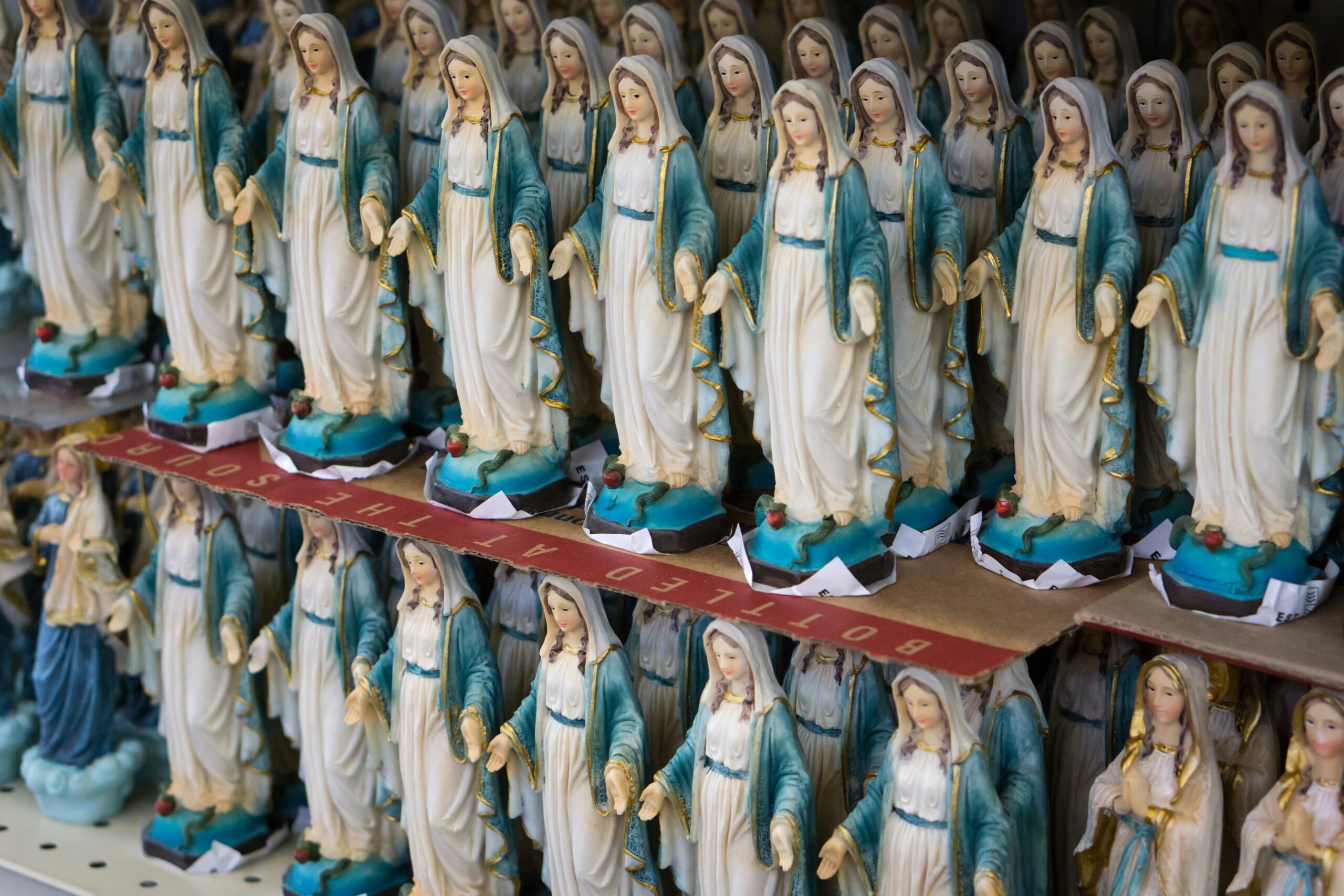
My mom was in tremendous shock when I came home one day and told her to burn all our Catholic statues.
For a moment, she thought that I was already out of my mind.
Our family had always been Catholic, and my grandparents gave us several religious icons that I grew up with – a statue of Our Lady of Fatima, pictures of the Last Supper and the Agony in the Garden, statues of the saints like St. Martin de Porres, rosaries, prayer books, etc.
During that time, I was so passionate about my newly-found born again Christian faith, and I told mom, “Those statues are forbidden by God. We should serve Him not with statues but ‘in spirit and in truth’ (John 4.24). This is the idolatry that the Lord spoke about.”
“But we never worshipped statues,” my mom desperately reasoned to no avail.
Then I did what all born again Christians would normally do – quote scriptures.
“Mom,” I started, trying to keep my calm knowing how mistaken she was. “The Bible is telling us in Exodus 20:4-5, ‘You shall not make for yourself a graven image or any likeness of anything that is in heaven above, or that is in the earth beneath, or that is in the water under the earth: you shall not bow down to them or worship them.’ It was also written that people sinned against the Lord by making for themselves “gods of gold” (Exodus 32:31).
Then my mom did what many Catholics would do when confronted by a bible-quoting Christian – be silent.
And for many years she was silent.
She silently kept the statues, hid the rosaries, and removed any signs of Catholicism in the house.
She did that not because she totally believed in me and my new faith, but she just wanted to keep our house a peaceful home.
I was pleased at how my mom was trying to live “authentic Christianity.” Slowly, she also stopped attending Mass since I also told her that it was of no value – that it was a desecration of Christ’s finished work on the Cross. Together, we stopped receiving the sacraments, and we became active born-again Christians while mom silently cherished her old faith in her heart.
Many years after that incident, before I became a “born-again Catholic,” the Lord humbled me and showed me how I failed to truly understand the faith of my childhood.
Many years after, I realized how I misunderstood Catholics when I concluded that they commit idolatry by worshipping statues.
Many years after, I couldn’t agree more with what Bishop Fulton Sheen said, “There are not one hundred people … who hate the Catholic Church, but there are millions who hate what they wrongly perceive the Catholic Church to be.”
In my own journey of faith, I have realised three things about the statues of the saints.
God actually commanded the creation of statues.
It was a great shock for me when I learned that just five chapters ahead of the very book I was quoting (Exodus 20), the Lord had commanded the making of statues of angels when he told Moses to create the Ark of the Covenant!
It reads:
“And you shall make two cherubim of gold [i.e., two gold statues of angels]; of hammered work shall you make them, on the two ends of the mercy seat. Make one cherub on the one end, and one cherub on the other end; of one piece of the mercy seat shall you make the cherubim on its two ends. The cherubim shall spread out their wings above, overshadowing the mercy seat with their wings, their faces one to another; toward the mercy seat shall the faces of the cherubim be” (Ex. 25:18–20, emphasis added).
That made me doubt my deeply-held beliefs as a Protestant and made me want to “search the Scriptures” (John 5:39) even more. As I dug deeper, I also saw that in another instance, God seemingly contradicted Himself with regard to the creation of statues when King Solomon made a temple for God with carved figures of cherubims, palm trees, and open flowers overlaid with gold (1 Kings 6:23, 27, 29, 31, 32).
As Catholic apologist Tim Staples observed, “King Solomon ordered the construction of multiple images of things both “in heaven above” (angels) and “in the earth beneath” (palm trees and open flowers). And then, after the completion of the temple, God declared he was pleased with its construction (1 Kgs. 9:3). Didn’t God know what King Solomon had done?”
That question stayed with me for many years.
Why did God prohibit the making of graven images and then at another instance demand it?
There must be an explanation that would make sense. I tried asking my Protestant friends, but many of them were not even aware that God allowed statues to be made in the first place! That’s the time I realized that perhaps my mom was right – perhaps at least on this aspect Catholics are right.
As I read more about the topic, I realized another surprising truth.
God even used statues and other material things to transmit graces.
Prior to becoming a “born-again Catholic“, I also abhorred the use of religious icons (statues and images) in the context of healing. For me, that was not just idolatry but superstition.
And yet, I was unaware that Scriptures spoke of how God used material things to transmit grace.
During the exodus of the Jews, there was a plague of serpents sent to punish them. Moses could have simply told his people to pray for deliverance, but God had another plan. He told the prophet: “make [a statue of] a fiery serpent, and set it on a pole; and every one who is bitten, when he sees it shall live. So Moses made a bronze serpent, and set it on a pole; and if a serpent bit any man, he would look at the bronze serpent and live” (Numbers 21:8–9).
In the New Testament, God also worked through St. Paul “so that even handkerchiefs and aprons that had touched him were taken to the sick, and their illnesses were cured and the evil spirits left them” (Acts 19:12).
Mind you, when I read those passages, I was completely blown away.
I finally understood how I misunderstood Catholics all along.
Clearly, God in His wisdom and power can work through material things. Clearly, God did not abhor nor prohibit the creation of statues and their use in right religious contexts.
Reading Exodus 20:5 once more, I also realized a simple but fundamental detail in understanding this entire issue – “you shall not bow down to them [the graven images – statues] or serve them.”
When I tried researching about this verse, I found an interesting insight as I looked at the original Hebrew with which the Old Testament was written.
“Bow down” or shachah (שָׁחָה) and “serve” or abad (עָבַד) both mean the same thing – to worship. I saw in the dictionary that worship means “adoration of a deity.”
Therefore, it became clear to me that what God prohibited was not the creation of statues and religious icons per se – but the act of adoring them and considering them as gods!
I also realized that we have to take the whole context of Exodus 20 into consideration. What God prohibited was the worship of false gods that the people did when they were adoring nature, the animals, and the skies. Hence, God didn’t want them to make statues of their likeness and worship them.
Bowing doesn’t automatically imply adoration of God
While bowing is definitely one of the signs and gestures of worship, I have realized that not all bowing are acts of adoration. When two Japanese politely greet each other by bowing reverently, I think I’d be absurd to conclude that they are worshipping each other. The same goes for people giving honor to the king and other members of a royal family or even just the elderly.
I was also surprised to discover that the Bible is full of stories where people would bow without necessarily committing idolatry:
- Jacob bowed to the ground on his knees seven times before his elder brother Esau (Genesis 33:3);
- Bathsheba bowed to her husband David (1 Kings 1:16); and,
- Solomon bowed to his mother Bathsheba (1 Kings 2:19).
Another thing that blew me away is that in Revelation 3:9, St. John records the words of Jesus saying that those who are of Satan “will come and bow down” before our feet.
What Now? My Conclusion and Invitation
When I came back to the Church, my mom knew that God heard her fervent prayers. I finally understood the purpose of our religious icons at home and in the Church – to direct our attention and contemplation to God and his saints who lived with deep devotion.
I never thought that I would become a Catholic again because my heart was set on becoming a pastor. However, God’s ways are higher than my ways and being Catholic again is the best thing that has ever happened to me.
Here’s one request that I’d like to make, especially for non-Catholics – whenever you see a Catholic bowing reverently or praying prostrate on the ground before a statue of Jesus, Mary, and the saints, instead of thinking that he’s an idolater, pray for him and his intentions. And when you get the chance to ask him about his gesture, don’t be surprised when he tells you he is not worshipping that statue. He may not give you all the bible verses you’d like to hear, but trust me when I say that he knows very well in his heart that those statues are not his gods.
Let us constantly ask from God the humility to avoid judging the internal dispositions of people based solely on their external actions.
My friend, there’s so much goodness and beauty yet to be seen in the Catholic Faith. I hope you could keep an open mind and study it further with an open heart. I am just here to guide you. I invite you in this journey to rediscover this “pearl of great price” that Jesus and millions of people offered their lives for.

Leave a Reply