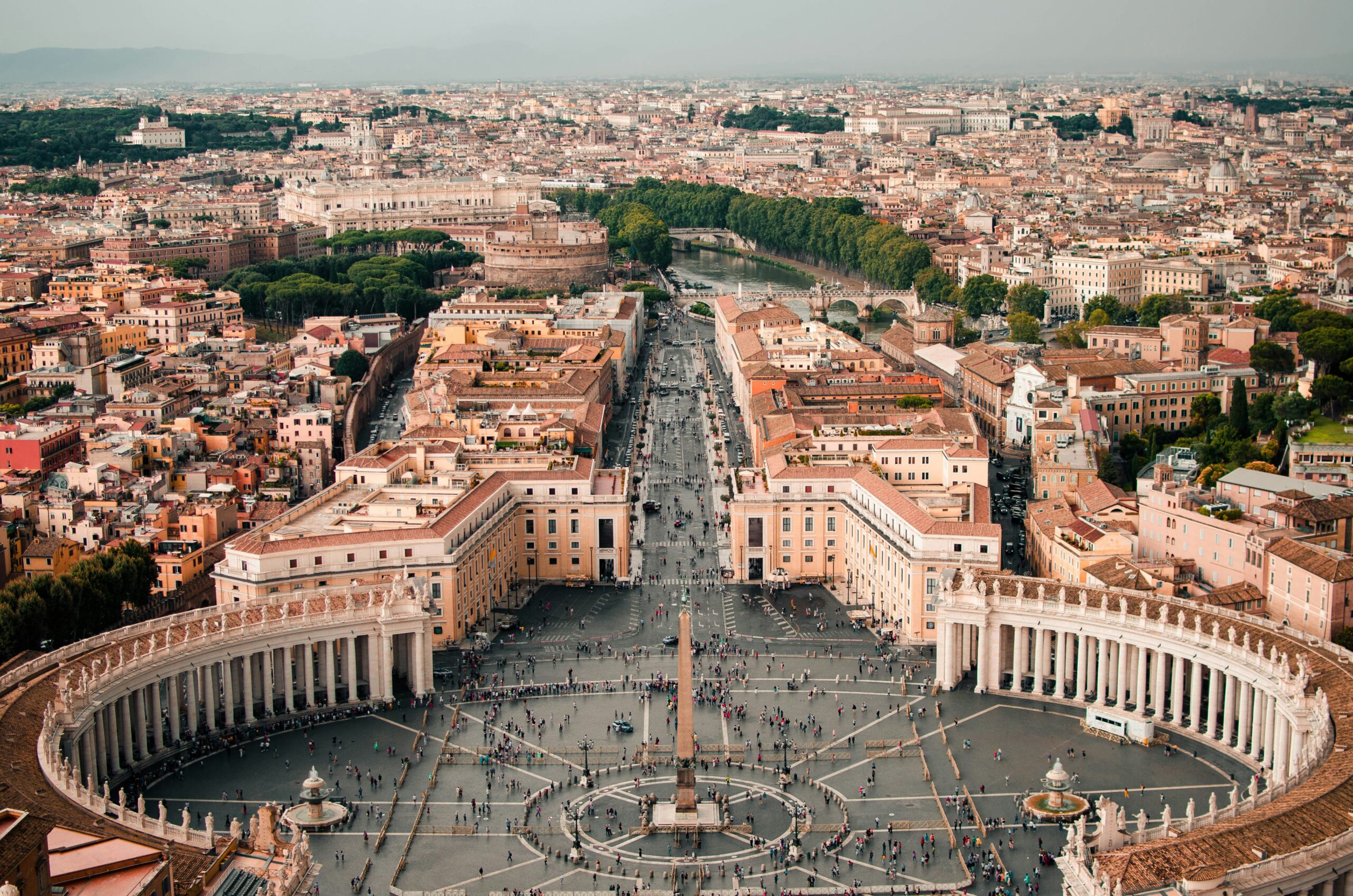
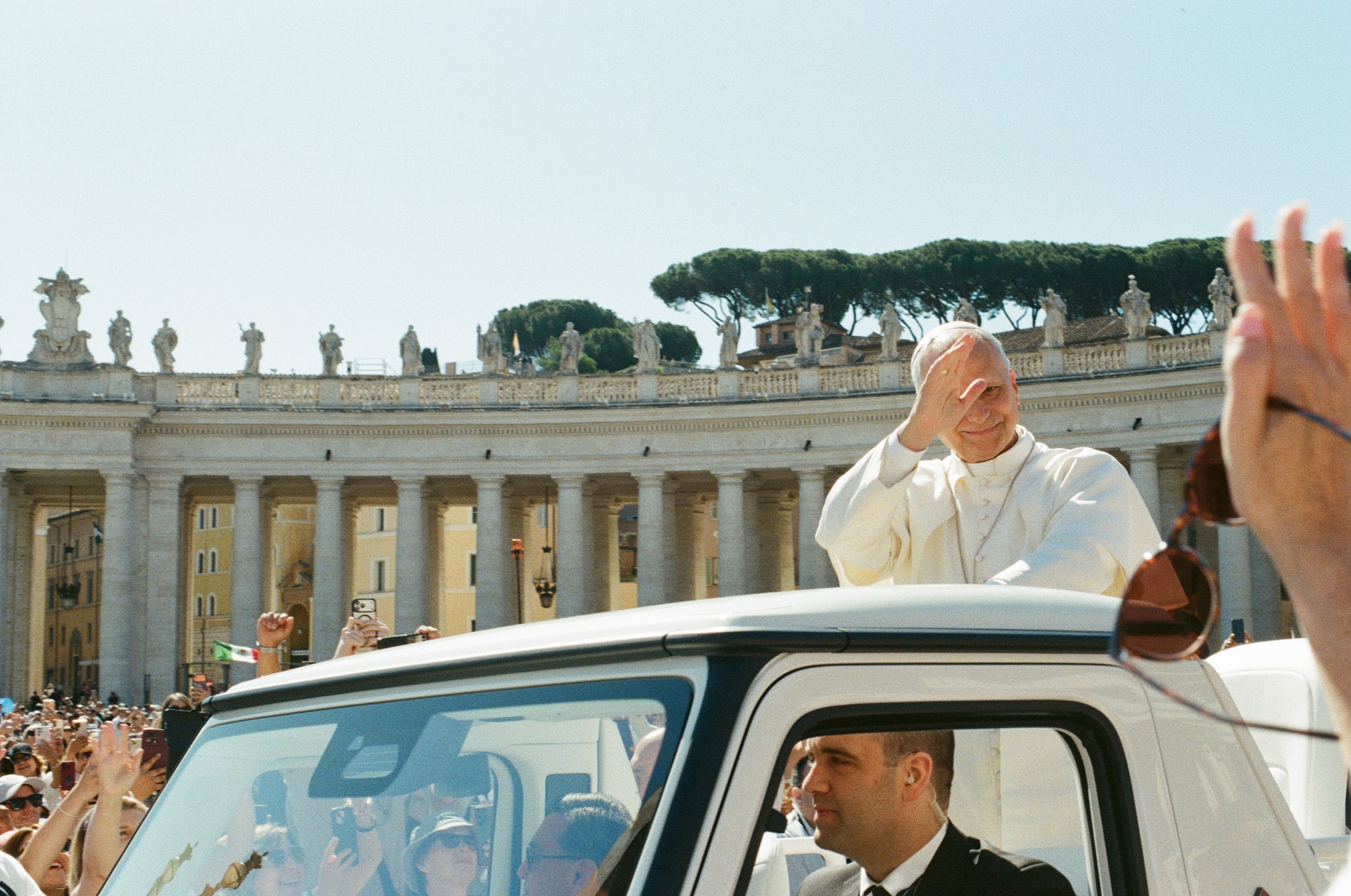
Author: Bernz Ordoñez Caasi

  • The Pope Through My Pentax: I Used to Call Him the Antichrist

    The Pope Through My Pentax: I Used to Call Him the Antichrist

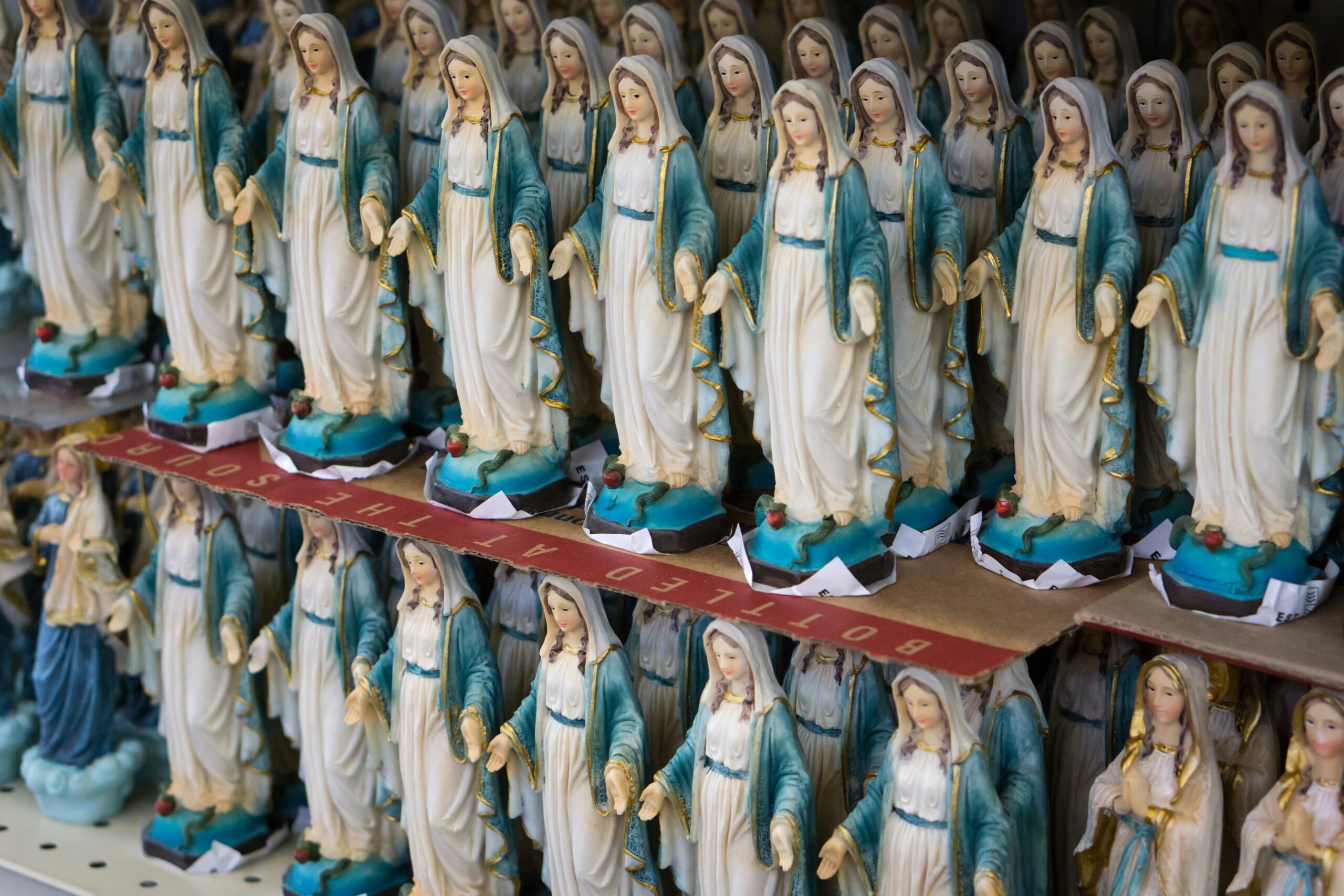
    I once told my mom to burn the statues of the saints.

    I once told people that the papacy was an invention — a corruption, something unbiblical.

    I once believed a “visionary” who claimed to have seen Pope John Paul II burning in hell beside Michael Jackson.

    I was convinced he was the Antichrist.

    That was me more than ten years ago.
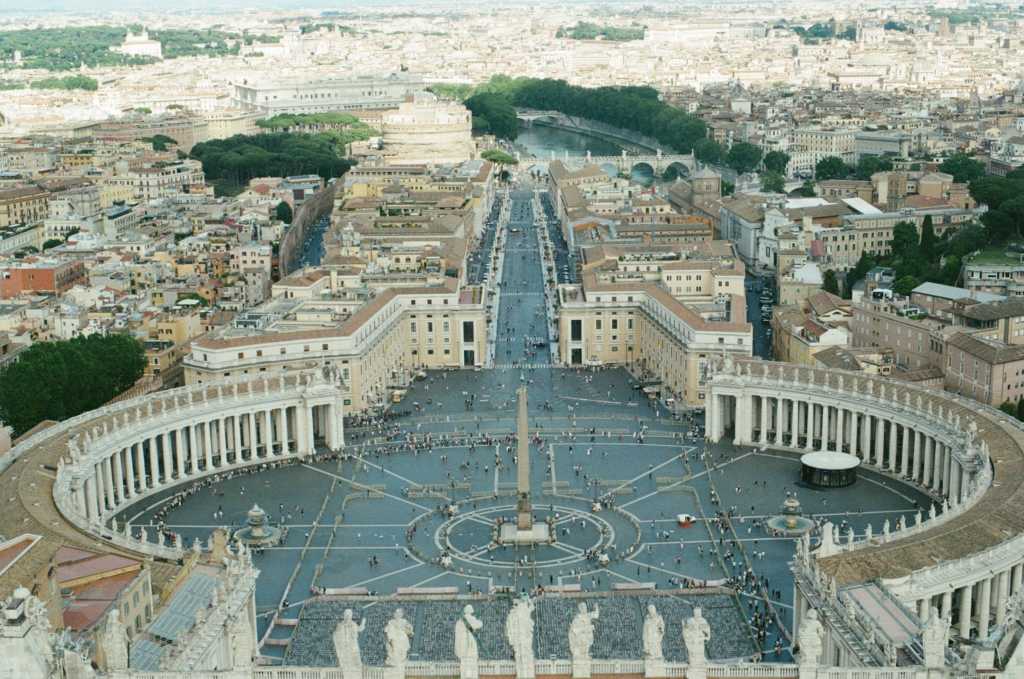
    St. Peter’s Square from the cupola — the same square where I would later try to capture the Pope on film.
    Shot on Pentax K1000 with Kodak UltraMax 400. © Bernz O. Caasi, 2026

    The Second Time I Came to Rome

    Last May, I returned to Rome and visited Assisi with my mom, my teammates at Hallow App, my Pentax K1000, and a box of color and black-and-white film rolls.

    It was my second time in Rome.
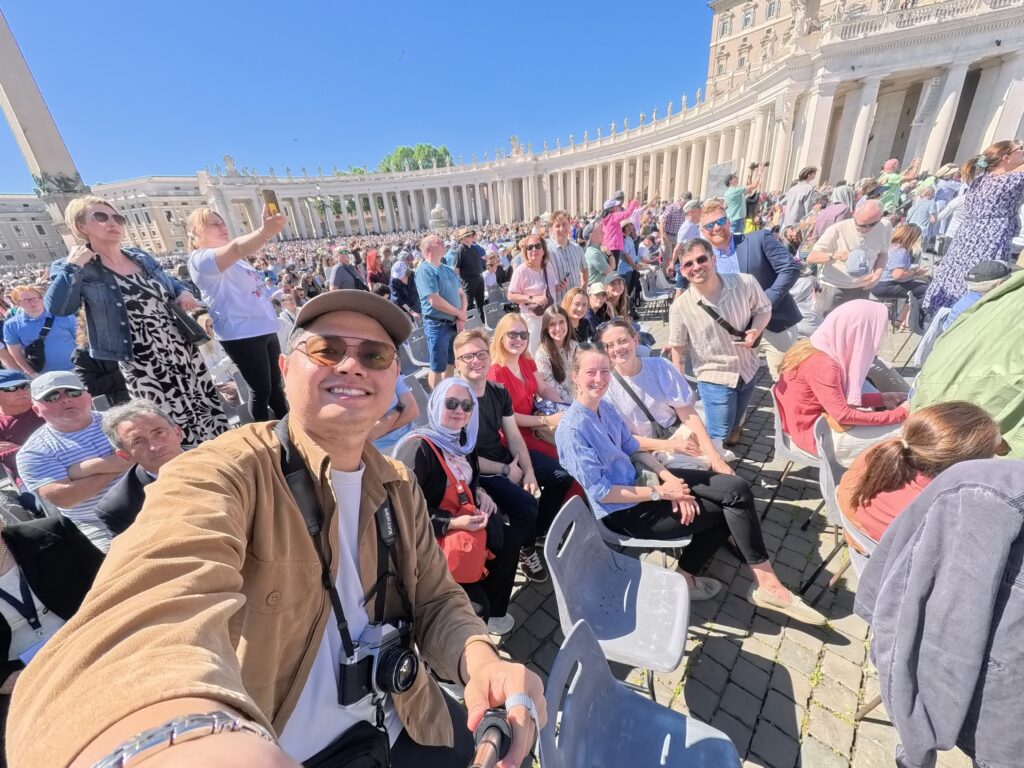
    I was with some members of our team at the Hallow Prayer App.

    The first was after the 2023 World Youth Day — a week with Pope Francis and more than one million young people from all over the world. I saw him a couple of times from afar, in Lisbon and in Manila back in 2015, but never close enough to feel the weight of the moment.

    This time was different.

    In 2026, about a year after the death of his Argentinian predecessor, I had the chance to see Pope Leo XIV — the first American pope, the 267th pontiff, and the latest successor of St. Peter in a line that has endured for two thousand years.
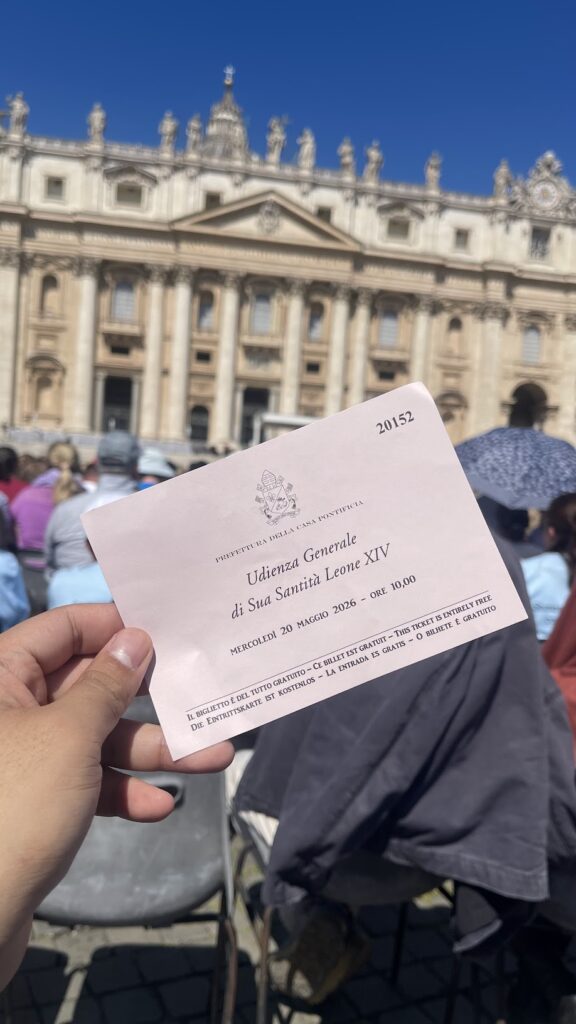
    The ticket for the Pope’s General Audience. It’s free!

    We started queuing for security checks at the Vatican around 8:30 AM to secure a good spot for his 10 AM Wednesday General Audience.

    The lines were long, but we made it just in time to stand by the barricade where the popemobile would pass.

    How I Set Up My Pentax K1000 to Shoot the Pope

    To make sure I’d get to capture the full moment as it unfolded, I brought my Insta360 Go Ultra digital camera with me, but I forgot the magnetic mount I was going to clip onto my cap.

    So I had to improvise.

    I wrapped Insta360’s magnetic necklace around my head and attached the Go Ultra for a hands-free POV shot.

    Problem solved.
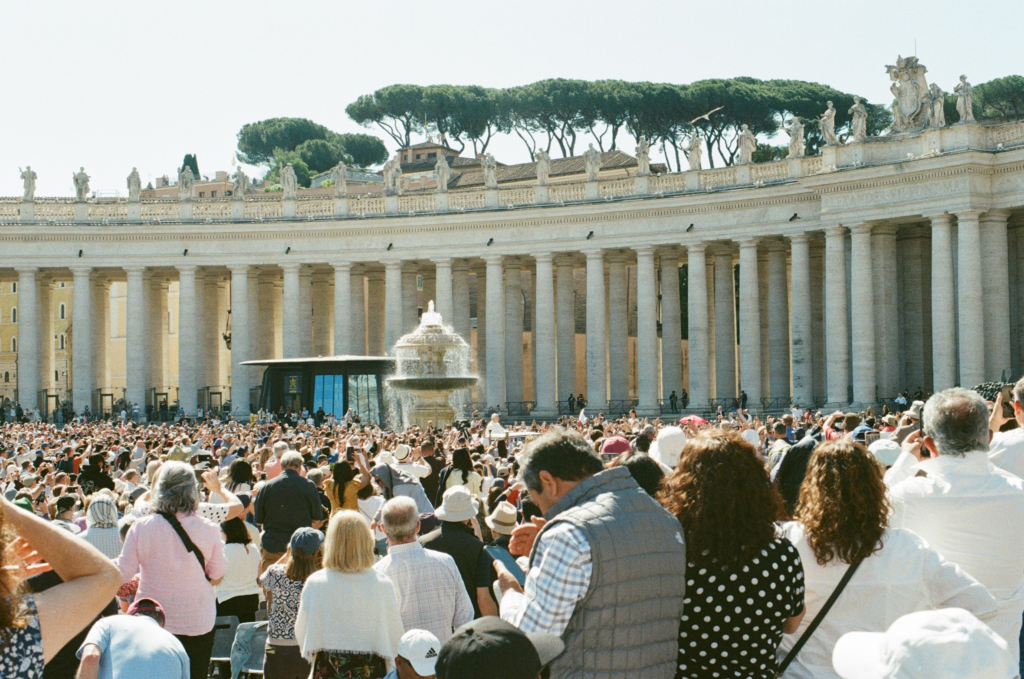
    Waiting in St. Peter’s Square as the cheers began to move through the crowd.
    Shot on Pentax K1000 with Kodak UltraMax 400. © Bernz O. Caasi, 2026

    Now both of my hands were free for my Pentax camera.

    After all, that was my main intention.

    To experience the moment with intention and then capture it on film.

    I started film photography just seven months ago, and it has quietly become one of the most contemplative things I do. As a Catholic revert, I prayed for the grace to capture this moment with my Pentax K1000, loaded with a roll of Kodak Ultramax 400.

    As the popemobile began its rounds around St. Peter’s Square, we could already hear the crowd cheering in waves as the Pope approached. When the excitement around us peaked, I hit record on the Go Ultra — then turned my full attention to the Pentax.

    ISO set to box speed 400. Check.

    Aperture around f/16 for Vatican’s sunny skies. Check.

    Manual focus pre-dialed and estimated for where the Pope would pass. Check.

    Shutter speed set to 1/1000 — he would pass quickly. Check.

    Film advance lever fully wound, ready to fire. Check.

    I thought I was ready.
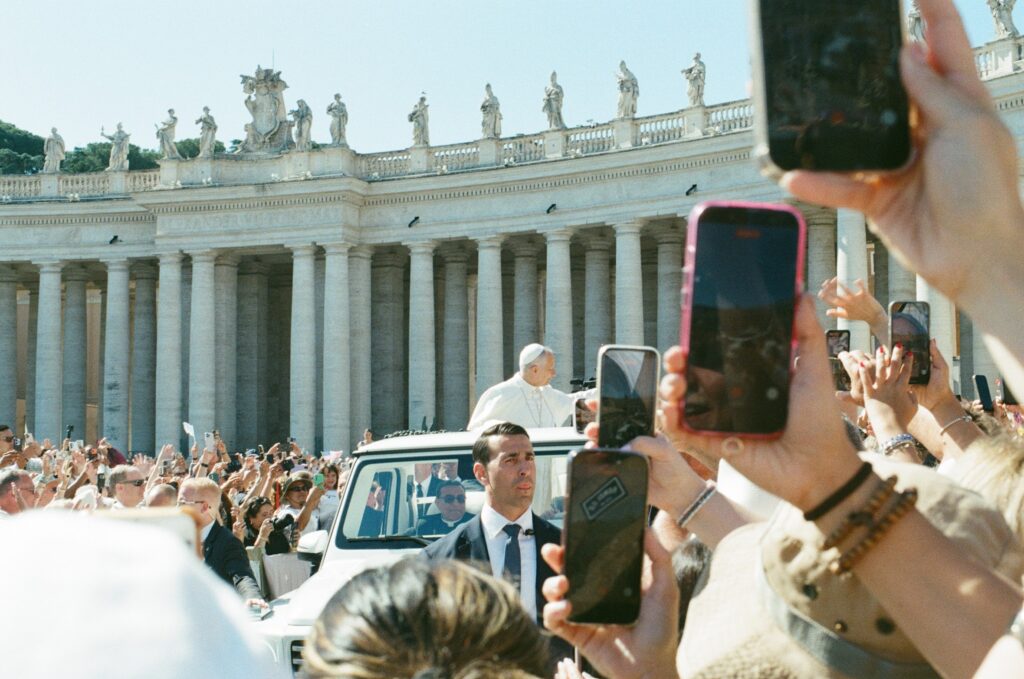
    Ancient stones. Modern phones. One Pope. One Church.
    Shot on Pentax K1000 with Kodak UltraMax 400. © Bernz O. Caasi, 2026

    The Moment Pope Leo Passed in Front of Me

    Then Pope Leo came into view — and stopped.

    A baby had caught his attention.

    That bought me time.

    I raised the Pentax to my eye, looked through the viewfinder, and estimated the manual focus. I adjusted the aperture to what the light meter needle was telling me.

    And when he was passing directly in front of me, I looked at him with my eyes first.

    I wanted to be fully present in that brief moment.

    I was stunned.

    For a few seconds, he was not “the Pope” as an idea, or an office, or a theological argument I once rejected.

    He was there.

    In flesh.

    In front of me.

    Watch this moment unfold before my eyes:

    A moment I’ll never forget: Pope Leo XIV passing right in front of us in St. Peter’s Square. You can even hear the sound of my camera shutter. Captured on Insta360 GO Ultra. © Bernz O. Caasi, 2026

    Before I saw the successor of Peter through my camera’s viewfinder, I received him first with the lens of my soul.

    Then I lifted the camera, quickly adjusted focus, and pressed the shutter.

    One shot. Wind.

    Another. Wind.

    Then another.

    No screen to check.

    No preview.

    No second chance to take a better shot.

    I just had to surrender to the shutter and the process.

    That’s one of the things I love and fear about film.

    You see first. You trust. Then you wait.

    All I was certain of was this: there I was, a former Protestant who once called the Pope the Antichrist, cherishing an unrepeatable moment with Pope Leo XIV in the flesh.

    It was surreal.
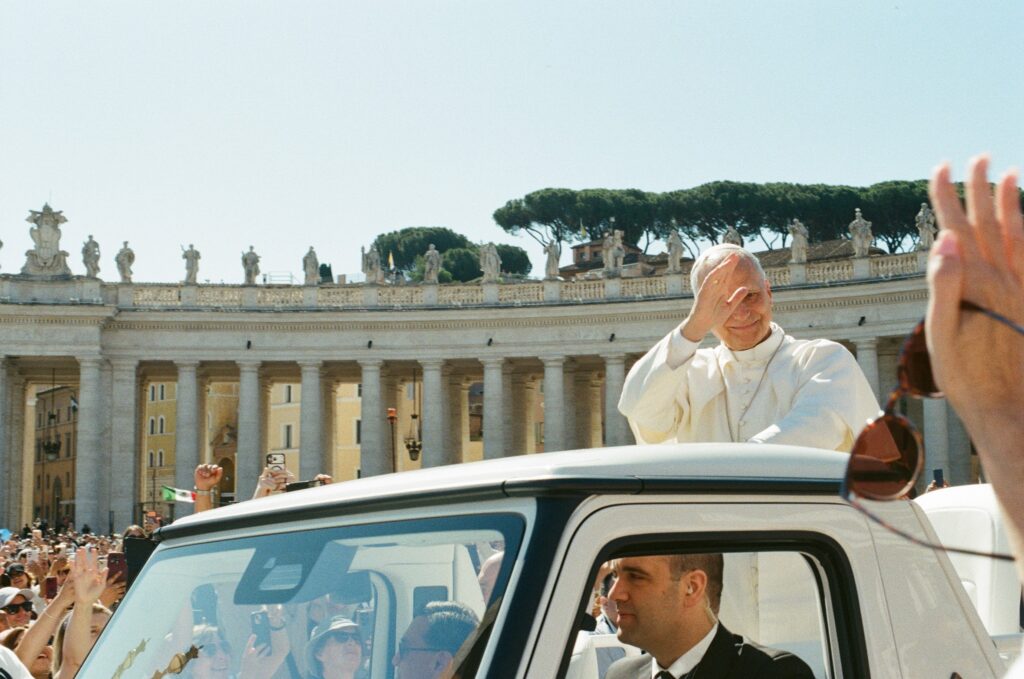
    Pope Leo XIV passing through St. Peter’s Square. Shot on Pentax K1000 with Kodak UltraMax 400.
    © Bernz O. Caasi, 2026

    Why the Papacy Still Stands After 2,000 Years

    As he drove farther away from us, many thoughts came to my mind.

    I remembered how I once told my mom to burn the statues of the saints.

    I remembered how I once told people the papacy was a corruption not found in the Bible.

    I remembered how I believed a visionary who claimed the Pope was burning in hell.

    Oh, how I misunderstood and judged the Catholic faith with prejudiced eyes.

    And now here I was — lifting a lens to capture the face of St. Peter’s successor — filled with a mixture of awe and sadness.

    Awe — because 2,000 years after Jesus established His Church, Peter’s office still stands.
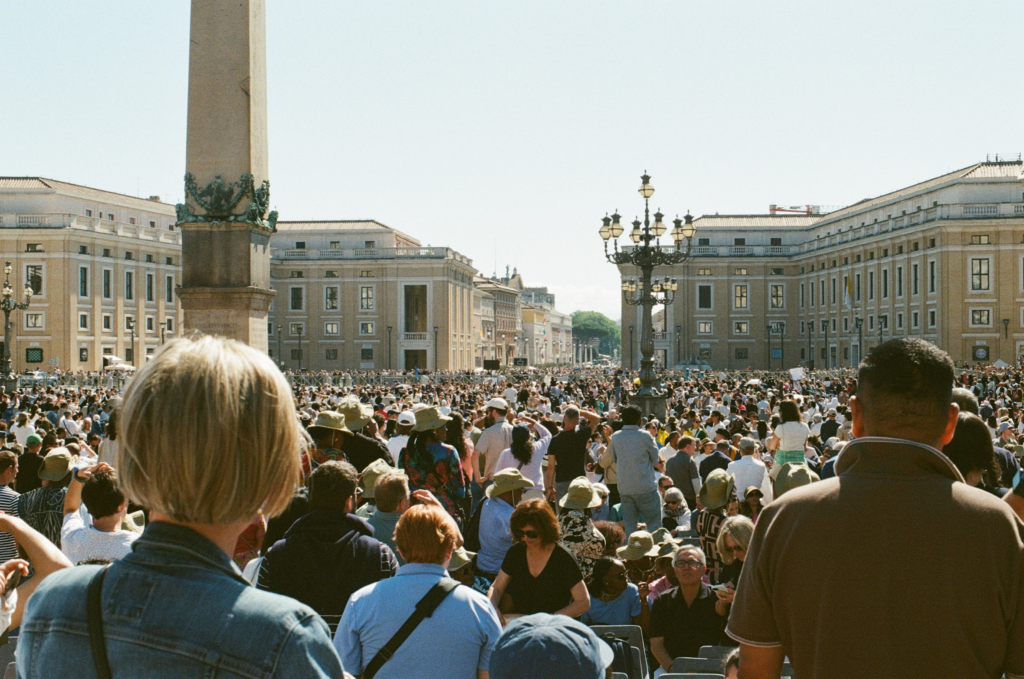
    Pope Leo passing through the crowds with the column in view. Shot on Pentax K1000 with Kodak UltraMax 400. © Bernz O. Caasi, 2026

    In the Old Testament, the steward of the kingdom is entrusted with the key of the house of David. He opens, and no one shuts. He shuts, and no one opens. In Matthew 16, Jesus echoes that same language from Isaiah 22 — and gives Peter the keys of the Kingdom.

    That’s what finally made sense to me as a Catholic.

    The Pope is not a replacement for Christ.

    Christ is King.

    But the Pope is His steward. His “Prime Minister.” The visible holder of the keys until the King returns.

    And there he was, right in front of me.

    The Holy Roman Empire was once powerful but now remains as museum pieces. Empires have fallen. Ideologies have risen and collapsed. Kings have died and been forgotten.

    But the papacy endures.

    I had just seen the Pope right in front of me, and I captured a brief moment of Church history unfolding before my Pentax K1000.

    But I also felt sadness.

    Sadness because, like I once was, many people still misunderstand the office of the Pope and his importance to the Christian faith. I captured his face in my camera and in my heart. And in that same moment, I prayed for the grace to help others see what I now see.

    When the Pope finished his rounds and settled into his chair in front of the Basilica, his image appeared on the screen in the square. Behind that screen stood the statue of St. Peter — holding the key.
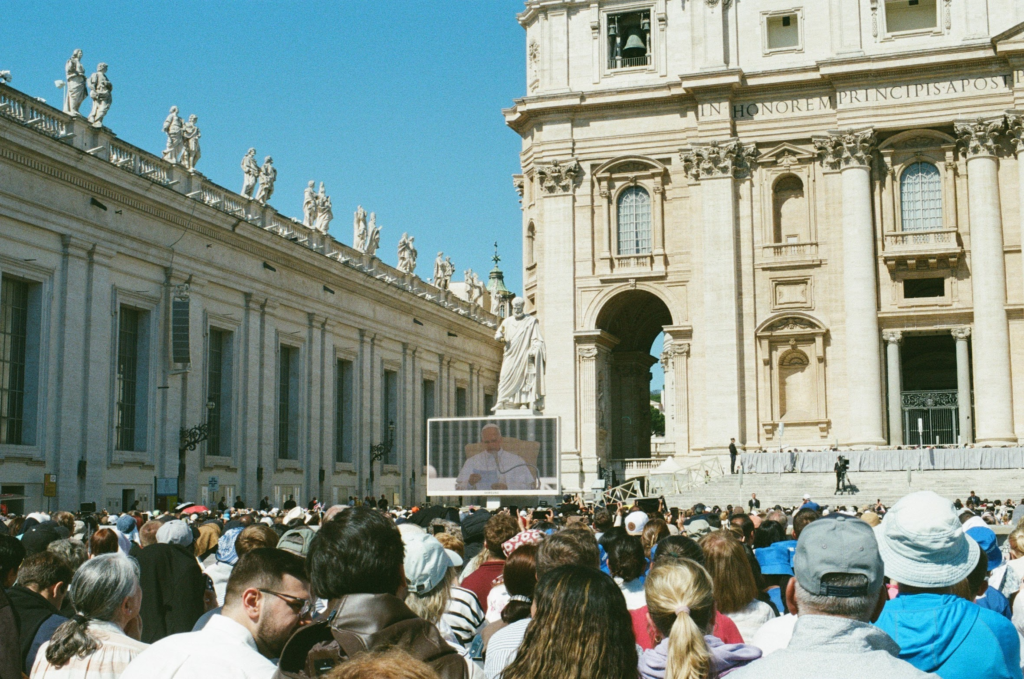
    The 267th pope beneath the gaze of Peter himself. Shot on Pentax K1000 with Kodak UltraMax 400.
    © Bernz O. Caasi, 2026

    I didn’t just see a big screen.

    I saw past and present held together.

    The image of our Church’s enduring legacy and unfolding story.

    There he was, the 267th pope, teaching the faithful and pointing us to Jesus, framed beneath the gaze of Peter himself.

    “You are Peter, and on this rock I will build my Church.”

    God has never left us orphans.

    The Holy Spirit continues guiding the Church.

    The Pope continues being the Prime Minister of Our Lord.

    A Bird, a Window, and the Angelus

    On another day, during the Angelus, I took a very different kind of photo.

    No popemobile.

    No crowd pressing forward.

    No quick moment to catch before it passed.

    Just the Apostolic Palace rising against a blue sky. The colonnade curving below. The statues of the saints standing watch. And somewhere in that building — in a small window draped in red — a tiny figure, barely visible, speaking to thousands.

    And above it all, a single bird in flight.
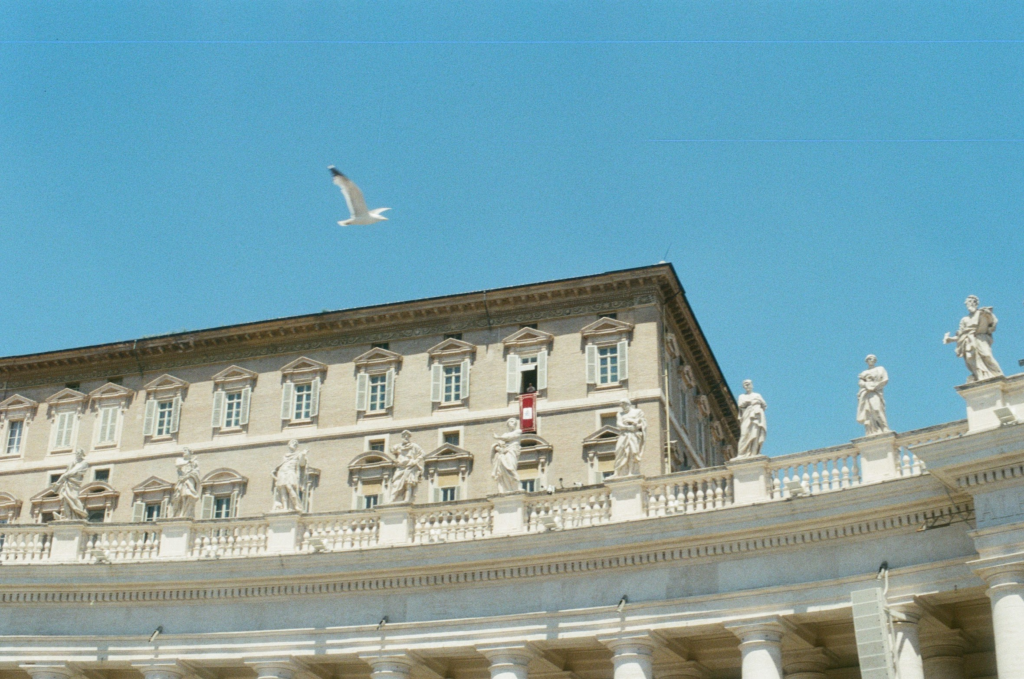
    A small window, a distant voice, and Peter still there. Shot on Pentax K1000 with Kodak UltraMax 400. © Bernz O. Caasi, 2026

    I didn’t plan that frame. Film doesn’t let you plan. You point, you shoot, you trust.

    But I think that photo belongs to this story — because the papacy is both near and far.

    Sometimes the Pope passes right in front of you.

    Sometimes he speaks from a window.

    Sometimes you see his face.

    Sometimes you only hear his voice.

    And sometimes there’s a bird in the frame to remind you that the Holy Spirit still guides the Church.

    But either way, Peter is still there.

    What the Film Revealed Three Weeks Later

    Three weeks later, I developed ten rolls of film from Hong Kong, Rome, and Assisi.

    I was nervous.

    For someone seven months into film photography, shooting on a fully manual camera in a moving crowd, with limited shots to get it right — I wasn’t sure what I’d find on those negatives.

    But grace, apparently, has good timing.

    The shot I love most is the one where Pope Leo appears to be looking directly at my camera as he waves. It brought back everything — the closeness I felt in that moment, the stillness inside the noise, the strange intimacy of being one face in thousands and still feeling seen.

    He didn’t know I was there.

    But the film remembers.

    There’s also the back shot — the Pope facing the crowd, arm raised, the colonnade sweeping behind him. That one makes me feel like I’m still there, still in the crowd, still receiving the grace of the moment rather than just documenting it.

    And then there’s the wide frame: a sea of smartphones aimed at the Pope, the ancient colonnade rising behind them, pilgrims from every nation crowded together under the same Roman sky.

    Ancient stones.

    Modern phones.

    One Pope.

    One Church.

    Somewhere in that frame is a person holding a Pentax K1000 — no autofocus, no screen — trusting a roll of film to hold what my heart already contemplated.

    I used to call the Pope the Antichrist.

    Now I raise my Pentax to remember him as our Holy Father.

    And maybe that is the bigger picture God was developing all along.

    If you were taught to fear or hate the papacy the way I once did, I hope this story gives you permission to look again — not with panic, not with caricature, but with patience, Scripture, history, and prayer.
  • Leaving Catholicism? Here are Five Things to Reflect On

    Leaving Catholicism? Here are Five Things to Reflect On

    Are you feeling confused, frustrated, or quietly exhausted with Catholicism?

    Maybe you’ve been comparing the Mass to the “praise and worship” of your born-again friends. Maybe their pastor’s sermons feel more engaging, their music more alive, their communities warmer. Or maybe you’ve been faithful—kneeling, singing, serving—yet still feel empty, as if you’re only going through the motions of tradition.

    If that’s where you are, I want you to know this first: you’re not alone.

    More than ten years ago, I left the Catholic faith myself. I was searching for a deeper relationship with the Lord—one I honestly thought I couldn’t find in the Church. By God’s grace, I eventually found my way back, and that journey gave birth to Unboxing Catholicism.

    I’m not here to pressure you into staying Catholic or to argue you into belief. I’m here to discern with you as a friend—someone who has stood where you’re standing now.

    Before you decide to leave the Church, I invite you to pause and reflect on five things. Not to rush your decision—but to deepen it.

    This reflection is also available as a video. If you prefer to listen or watch in Taglish, you can view it here.


    1. Write your questions down—don’t just carry them in your head

    When confusion stays in our head, it grows heavier and more tangled. Over time, that becomes exhausting. That’s why the first step is simple but demanding: write everything down.

    Write every doubt, frustration, comparison, and disappointment you have about the Catholic faith. Don’t filter. Don’t organize yet. Just name them.

    And if I may suggest something countercultural: use pen and paper—or in my case, even a typewriter.

    Writing by hand slows us down.

    It forces clarity. It gives space for honesty and prayer in a way screens often don’t. When I reflect using a fountain pen, a Blackwing pencil, or a typewriter, I enter a kind of interior “flow.” Thoughts surface that I didn’t even realize were there.

    Discernment begins with naming. What remains unnamed quietly controls us.


    2. Learn to distinguish the kinds of questions you’re asking

    Once your questions are written, don’t leave them as one overwhelming list. Group them.

    This matters more than we often realize.

    Most doubts fall into four categories:

    Doctrinal questions
    These concern what the Church teaches
    Why do Catholics pray to saints? Why are there statues? Why is there purgatory? Why does the Catholic Bible have more books?

    Moral questions
    These concern how Catholics live:
    Why does the Church oppose divorce, contraception, or same-sex marriage? Why does it seem “behind the times”?

    Spiritual or experiential questions
    These are deeply personal:
    Why don’t I feel God in the Mass? Why does worship elsewhere feel more alive? Why do I feel spiritually dry here?

    Relational or institutional wounds
    These are often the deepest:
    Were you hurt by a priest, a parish leader, a parent, or a church community? Did you witness hypocrisy, scandal, or corruption?

    These wounds are real—and they should never be dismissed.

    But here’s the danger: when we don’t name these properly, we can end up mistaking human failure for divine truth. We may conclude that Catholicism itself is false when what actually wounded us was the behavior of broken people.

    Distinguishing these questions is an act of justice—to God, to the Church, and to yourself.


    3. Don’t discern alone—seek well-formed Catholics

    When I was deeply confused about the faith, I often heard this line:
    “All religions are basically the same—why bother comparing them?”

    What shook me most, however, wasn’t Protestant arguments. It was the painful realization that many Catholics around me couldn’t explain their own faith. My born-again friends knew Scripture well. Many Catholics I knew did not. That disappointed me deeply and made me feel almost betrayed—because if Catholicism were true, shouldn’t it have answers to life’s deepest questions?

    Everything changed when I encountered in the university Catholics who were not only kind and prayerful, but intellectually formed. They could explain doctrine clearly. They could show that Catholic teaching was biblical, reasonable, and coherent.

    That encounter changed my life.

    Before you decide to leave, talk to someone who actually understands the faith: a priest, a catechist, a mentor, or a well-formed Catholic friend.

    Read the Catechism of the Catholic Church—it’s free online. Explore faithful resources like the Hallow Prayer App, Catholic Answers, Word on Fire, Opus Dei Youth, Ascension Press, and solid local Catholic voices. Truth is not afraid of questions—but it often requires guidance.

    Scripture itself reminds us: “In an abundance of counselors there is safety” (Proverbs 11:14). Faith was never meant to be a solo journey.


    4. Be careful of oversimplifying Christianity

    When I was still an anti-Catholic Protestant, I used to preach:
    “Religion doesn’t matter. What matters is a personal relationship with Jesus.”

    I vividly remember one afternoon at the university when a friend asked me if I truly believed what I was saying. I said yes—without hesitation. He then gently pointed out that I was contradicting myself.

    That same friend, a well-formed Catholic, explained to me that the word religion comes from the Latin religare, which means “to bind oneself”—to enter into relationship with God.

    I realized then that I had uncritically absorbed the slogan “relationship over religion” without ever reflecting deeply on what it meant.

    I understand the desire behind that statement. We want faith to be alive, personal, and real. But when faith becomes oversimplified, it often becomes misleading.

    Scripture itself speaks positively of religion:
    “Religion that is pure and undefiled before God the Father is this…” (James 1:27)

    To reject religion entirely while claiming relationship is not simplicity—it is contradiction, both logically and biblically. The problem isn’t religion; it’s bad religion.

    As a Protestant, I used to argue that Christian traditions were distractions that Jesus Himself condemned (e.g. Mark 7:8-9). But when read in context, Christ condemns human traditions that nullify God’s commandments, not apostolic traditions that faithfully transmit them.

    In fact, Scripture explicitly tells us to “stand firm and hold fast to the traditions” taught by word or by letter (2 Thessalonians 2:15). Faith is meant to be simple—but not shallow.

    I also once believed that Scripture was so clear that each believer could interpret it entirely on their own. Yet in Acts 8, the Ethiopian official reading Isaiah admits:
    “How can I understand unless someone guides me?”

    Scripture itself warns against private interpretation (see 2 Peter 1:20). Without the Church—without teaching authority and continuity—division multiplies endlessly.

    Christianity is not complicated, but it is complete. And completeness requires depth.


    5. If you are Catholic, you are already “born again”

    This surprises many people—but it is profoundly biblical.

    Jesus tells Nicodemus:
    “Unless one is born of water and the Spirit, he cannot enter the kingdom of God” (John 3:5).

    Immediately after this conversation, the disciples begin baptizing. The early Church clearly understood: to be born again happens through baptism.

    Scripture is explicit:
    “Baptism now saves you” (1 Peter 3:21).

    Baptism is not merely a symbol. It is a real encounter with saving grace—where we die with Christ and rise with Him (see Romans 6:4), and where God truly makes us His children (1 John 3:1).

    Salvation, however, is not a one-time moment. Scripture speaks of it in three tenses:

    • You have been saved (see Ephesians 2:8, Titus 3:5, 2 Timothy 1:9)
    • You are being saved (see 1 Corinthians 1:18 and 15:2, Philippians 2:12)
    • You will be saved (see Romans 5:10, 13:11, Matthew 24:13)

    Like love within a family, salvation is a relationship that must be lived, renewed, and deepened every single day.

    At every Mass, we receive Christ—not symbolically, but truly. We do not accept Him once; we receive Him again and again, especially in the Eucharist, after repentance and reconciliation.

    You do not need to search outside the Church for a “born-again experience.” The sacraments already place you at the very heart of Christ’s saving work. Often, what we need is not something new—but a deeper unboxing of what we already have.


    A final word

    I am not dismissing your pain. Your questions matter. Your wounds matter.

    My only invitation is this: separate your feelings about the Church from the truth of the faith itself.

    Slow down. Pray. Sit in silence before the Blessed Sacrament. Speak honestly to Jesus.

    There was a time I dreamed of becoming a pastor and church-planter. When the Lord slowly opened my mind to the possibility that Catholicism might be true, I became scared and confused. In that season, I begged God for one grace: that I would leave no stone unturned in my search for the Truth—and that I would have the humility and courage to follow wherever He led.

    That is my prayer for you as well.

    Ask Him—not for comfort alone—but for truth.

    The fullness of Truth.

    “You will seek me and find me when you seek me with all your heart” (Jeremiah 29:13).

    If you are confused, afraid, or tired—you are not alone. The journey of faith is not about shortcuts, but about depth. And Christ is patient with those who seek Him sincerely.

    I am here for you. If you need guidance, feel free to comment below—and I will try my best to walk with you.

  • How can God have a Mother?

    How can God have a Mother?

    How can God have a mother? 🤔

    I remember asking that question more than ten years ago.

    This morning, I realized how that very question eventually led me back to the Catholic Church. After praying, I sat in front of my typewriter and wrote this essay I’m sharing with you today.

    Did that mean Mary must also be God? Did it imply she existed before God?

    To me then, the title sounded not only illogical but dangerous—idolatrous, even heretical.

    I did not bother to read the Catechism or consult official Church teaching. Why would I? Nothing true should come out of Catholicism for what they teach is not biblical.

    Looking back, I see how deeply biased I was—how suspicious I had become of anything the Pope, the saints, or the Church had to say. I absorbed caricatures of Catholic belief as if they were gospel truth.

    At the time, I sincerely believed the Church had invented doctrines, added books to Scripture, and openly violated biblical prohibitions against idolatry. So when I heard Catholics call Mary the Mother of God, it became one of my strongest objections against the faith of my childhood.

    Fast forward to around 2015, when Pope Francis visited the Philippines. Something unexpected happened. I felt a calm interior nudge to revisit the beliefs I had long dismissed. It was a gentle invitation to give Catholicism one last look.

    Finally, I decided to be sincere and intellectually honest. I started studying actual Catholic sources that tried to explain with clarity the teachings of the Church. One of the most illuminating moments of that inquiry was realizing that even the early Protestant Reformers defended the title Mother of God.

    Martin Luther, in his 1521 Commentary on the Magnificat, wrote that all of Mary’s glory is “crowded into a single phrase: the Mother of God”. Throughout his life he asserted that no one can say anything greater of her than this title.

    What surprised me even more was discovering that Calvin, Zwingli, and other non-Catholic Christian figures I admired had no problem with the title either.

    That realization unsettled me.

    I began to see how little I actually understood the very doctrines I was so eager to reject. I had been arguing against non-Catholic interpretations of Catholic teachings without sincerely studying the Church’s reasons for her faith. In other words, I was contradicting caricatures, not convictions—debunking positions no one truly held.

    When I finally humbled myself and asked why this doctrine mattered so much to Catholics—and even to the early Reformers—the answer became clear: this was never primarily about Mary.

    It was about Jesus.

    To affirm that Mary is Theotokos—God-bearer—is to affirm that the one she carried in her womb was not merely a prophet, not merely a moral teacher, not merely a remarkable man, but the Word made flesh. Elizabeth already grasped this when she cried out, “Why is this granted to me, that the mother of my Lord should come to me?”

    Defending this title is ultimately about defending the divinity of Christ. If Jesus is not Lord, then He is something far less—and Christianity itself collapses into fiction or fanaticism.

    To declare Mary as Mother of God does not elevate her to the level of a goddess. It does not ascribe divinity to her. It simply proclaims that the Person she bore is fully God and fully man—the Second Person of the Blessed Trinity who entered history through her “yes.”

    Who Mary is always points to who her Son is.

    Every Marian title is an echo of Christology; every Marian devotion, when properly understood, deepens our faith in Jesus as God, Lord, and Savior.

    Mary’s role in our faith is maternal. She leads us by the hand to Christ, just as she did two thousand years ago. Whenever we contemplate her, we hear her quiet instruction at Cana: “Do whatever He tells you.”

    In the coming days, Filipino Catholics will celebrate the feasts of the Santo Niño and the Poong Nazareno—two liturgical reminders that the God who created the heavens and the earth chose to enter human history as a child, within a family, through a mother.

    But He did not only assume our weakness; He entered our suffering, carried our crosses, and loved with a love that bleeds.

    All of this was possible not only because He is God, but because He had a human mother whose humility and fidelity opened the door to our redemption.

    Today, as we pray to Mary, the Mother of God, we thank her for her yes. And we thank her for being our mother too.

    Mary, conceived without original sin, my Mother, lead me closer to your Son. Walk with me through this valley of darkness, that in the end I may find the light and rest promised to those who follow after you. Amen. 🙏

    Essay and photograph by Bernz Ordoñez Caasi
    Originally written on a 1958 Olympia SF typewriter
    Photographed on film (Pentax K1000, Kodak Gold 200)
    . First published on January 1, 2026 (Feast of Mary, Mother of God).

  • Why I Asked Mom to Burn the Statues of the Saints

    Why I Asked Mom to Burn the Statues of the Saints

    “Aren’t you scared of what you are saying? Have you already lost your respect for God and your grandparents?”

    My mom was in tremendous shock when I came home one day and told her to burn all our Catholic statues.

    For a moment, she thought that I was already out of my mind.

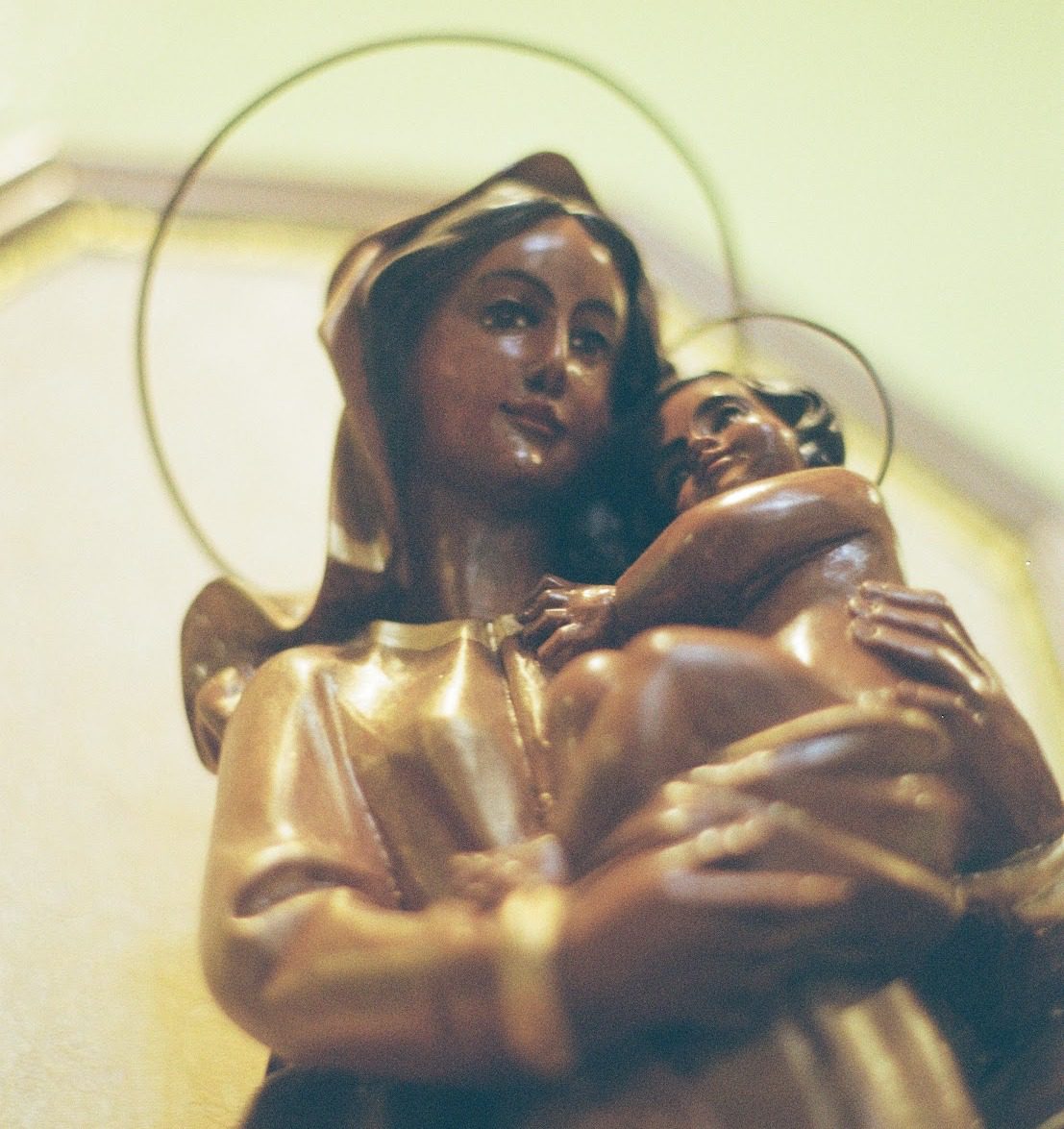
    Our family had always been Catholic, and my grandparents gave us several religious icons that I grew up with – a statue of Our Lady of Fatima, pictures of the Last Supper and the Agony in the Garden, statues of the saints like St. Martin de Porres, rosaries, prayer books, etc. 

    During that time, I was so passionate about my newly-found born again Christian faith, and I told mom, “Those statues are forbidden by God. We should serve Him not with statues but ‘in spirit and in truth’ (John 4.24). This is the idolatry that the Lord spoke about.

    “But we never worshipped statues,” my mom desperately reasoned to no avail.

    Then I did what all born again Christians would normally do – quote scriptures.

    Mom,” I started, trying to keep my calm knowing how mistaken she was. “The Bible is telling us in Exodus 20:4-5, ‘You shall not make for yourself a graven image or any likeness of anything that is in heaven above, or that is in the earth beneath, or that is in the water under the earth: you shall not bow down to them or worship them.’ It was also written that people sinned against the Lord by making for themselves “gods of gold” (Exodus 32:31).

    Then my mom did what many Catholics would do when confronted by a bible-quoting Christian – be silent. 

    And for many years she was silent.

    She silently kept the statues, hid the rosaries, and removed any signs of Catholicism in the house.

    She did that not because she totally believed in me and my new faith, but she just wanted to keep our house a peaceful home. 

    I was pleased at how my mom was trying to live “authentic Christianity.” Slowly, she also stopped attending Mass since I also told her that it was of no value – that it was a desecration of Christ’s finished work on the Cross. Together, we stopped receiving the sacraments, and we became active born-again Christians while mom silently cherished her old faith in her heart.

    Many years after that incident, before I became a “born-again Catholic,” the Lord humbled me and showed me how I failed to truly understand the faith of my childhood.

    Many years after, I realized how I misunderstood Catholics when I concluded that they commit idolatry by worshipping statues.

    Many years after, I couldn’t agree more with what Bishop Fulton Sheen said, “There are not one hundred people … who hate the Catholic Church, but there are millions who hate what they wrongly perceive the Catholic Church to be.”

    In my own journey of faith, I have realised three things about the statues of the saints.

    God actually commanded the creation of statues.

    It was a great shock for me when I learned that just five chapters ahead of the very book I was quoting (Exodus 20), the Lord had commanded the making of statues of angels when he told Moses to create the Ark of the Covenant!

    It reads:

    And you shall make two cherubim of gold [i.e., two gold statues of angels]; of hammered work shall you make them, on the two ends of the mercy seat. Make one cherub on the one end, and one cherub on the other end; of one piece of the mercy seat shall you make the cherubim on its two ends. The cherubim shall spread out their wings above, overshadowing the mercy seat with their wings, their faces one to another; toward the mercy seat shall the faces of the cherubim be” (Ex. 25:18–20, emphasis added). 

    That made me doubt my deeply-held beliefs as a Protestant and made me want to “search the Scriptures” (John 5:39) even more. As I dug deeper, I also saw that in another instance, God seemingly contradicted Himself with regard to the creation of statues when King Solomon made a temple for God with carved figures of cherubims, palm trees, and open flowers overlaid with gold (1 Kings 6:23, 27, 29, 31, 32).

    As Catholic apologist Tim Staples observed, “King Solomon ordered the construction of multiple images of things both “in heaven above” (angels) and “in the earth beneath” (palm trees and open flowers). And then, after the completion of the temple, God declared he was pleased with its construction (1 Kgs. 9:3). Didn’t God know what King Solomon had done?”

    That question stayed with me for many years.

    Why did God prohibit the making of graven images and then at another instance demand it?

    There must be an explanation that would make sense. I tried asking my Protestant friends, but many of them were not even aware that God allowed statues to be made in the first place! That’s the time I realized that perhaps my mom was right – perhaps at least on this aspect Catholics are right.

    As I read more about the topic, I realized another surprising truth.

    God even used statues and other material things to transmit graces.

    Prior to becoming a “born-again Catholic“, I also abhorred the use of religious icons (statues and images) in the context of healing. For me, that was not just idolatry but superstition.

    And yet, I was unaware that Scriptures spoke of how God used material things to transmit grace.

    During the exodus of the Jews, there was a plague of serpents sent to punish them. Moses could have simply told his people to pray for deliverance, but God had another plan. He told the prophet: “make [a statue of] a fiery serpent, and set it on a pole; and every one who is bitten, when he sees it shall live. So Moses made a bronze serpent, and set it on a pole; and if a serpent bit any man, he would look at the bronze serpent and live” (Numbers 21:8–9).

    In the New Testament, God also worked through St. Paul “so that even handkerchiefs and aprons that had touched him were taken to the sick, and their illnesses were cured and the evil spirits left them” (Acts 19:12). 

    Mind you, when I read those passages, I was completely blown away.

    I finally understood how I misunderstood Catholics all along.

    Clearly, God in His wisdom and power can work through material things. Clearly, God did not abhor nor prohibit the creation of statues and their use in right religious contexts

    Reading Exodus 20:5 once more, I also realized a simple but fundamental detail in understanding this entire issue – “you shall not bow down to them [the graven images – statues] or serve them.”

    When I tried researching about this verse, I found an interesting insight as I looked at the original Hebrew with which the Old Testament was written. 

    Bow down” or shachah (שָׁחָה) and “serve” or abad (עָבַד) both mean the same thing – to worship. I saw in the dictionary that worship means “adoration of a deity.”

    Therefore, it became clear to me that what God prohibited was not the creation of statues and religious icons per se – but the act of adoring them and considering them as gods!

    I also realized that we have to take the whole context of Exodus 20 into consideration. What God prohibited was the worship of false gods that the people did when they were adoring nature, the animals, and the skies. Hence, God didn’t want them to make statues of their likeness and worship them.

    Bowing doesn’t automatically imply adoration of God

    While bowing is definitely one of the signs and gestures of worship, I have realized that not all bowing are acts of adoration. When two Japanese politely greet each other by bowing reverently, I think I’d be absurd to conclude that they are worshipping each other. The same goes for people giving honor to the king and other members of a royal family or even just the elderly. 

    I was also surprised to discover that the Bible is full of stories where people would bow without necessarily committing idolatry:

    • Jacob bowed to the ground on his knees seven times before his elder brother Esau (Genesis 33:3);
    • Bathsheba bowed to her husband David (1 Kings 1:16); and,
    • Solomon bowed to his mother Bathsheba (1 Kings 2:19).

    Another thing that blew me away is that in Revelation 3:9, St. John records the words of Jesus saying that those who are of Satan “will come and bow down” before our feet

    What Now? My Conclusion and Invitation

    When I came back to the Church, my mom knew that God heard her fervent prayers. I finally understood the purpose of our religious icons at home and in the Church – to direct our attention and contemplation to God and his saints who lived with deep devotion.

    I never thought that I would become a Catholic again because my heart was set on becoming a pastor. However, God’s ways are higher than my ways and being Catholic again is the best thing that has ever happened to me.

    Here’s one request that I’d like to make, especially for non-Catholics – whenever you see a Catholic bowing reverently or praying prostrate on the ground before a statue of Jesus, Mary, and the saints, instead of thinking that he’s an idolater, pray for him and his intentions. And when you get the chance to ask him about his gesture, don’t be surprised when he tells you he is not worshipping that statue. He may not give you all the bible verses you’d like to hear, but trust me when I say that he knows very well in his heart that those statues are not his gods. 

    Let us constantly ask from God the humility to avoid judging the internal dispositions of people based solely on their external actions. 

    My friend, there’s so much goodness and beauty yet to be seen in the Catholic Faith. I hope you could keep an open mind and study it further with an open heart. I am just here to guide you. I invite you in this journey to rediscover this “pearl of great price” that Jesus and millions of people offered their lives for. 

  • What should I do about the Synod of the Church today?

    What should I do about the Synod of the Church today?

    Called by Pope Francis in October 2021 as a big family conversation, the Synod on Synodality is a special occasion where Christians worldwide are invited to share their thoughts and experiences to help shape the Church’s future.

    Literally, the Greek word “synod” means “walking together.”

    This gathering aims to make the Church feel more like a community where everyone’s voice matters. This invites us to envision a Church that resonates with the signs of the times while rooted firmly in apostolic teachings. It’s a call for every one of us to deepen our sense of communion, participation, and mission

    After launching the Unboxing Catholicism Podcast in March 2020, shortly after the Synod’s announcement, I prayed that we could use this platform to accompany Catholics in their desire to discover and defend the faith clearly without being preachy (check the ebook guide below later).

    As your friend, I offer you three practical suggestions on what you can do to be involved in this historic spiritual moment for the Church.

    Stay Informed, Stay Hopeful:

    Our journey of faith is deepened by doctrine, dialogue, and discernment.

    All of these elements are essential in our understanding of the synod. 

    Whether you consider yourself a “knowledgeable Catholic” or you are just hearing the word “synod” for the first time, I invite you to delve into reputable and balanced Catholic publications, YouTube channels, or podcasts to grasp the essence of the synod.

    For this, I strongly suggest that you consult a trusted spiritual director (lay or priest) who can help you discern which materials to use (here’s one) and how to make sense of opinions surrounding the synod.

    You don’t have to be an expert to be involved in this global process, but asking and reflecting on the basic questions would be a good starting point:

    1. What is the synod and why is this important in the life of the Church? 
    2. Why did the Holy Spirit inspire the Pope to call for this assembly at such a time as this?
    3. What are the activities in my parish or diocese that are related to the Synod? How can I participate in those?

    These are by no means exhaustive because my objective here is to just encourage you to unbox further.

    While doing your study, remember that in today’s synod, there are many who seem to fit St. John XXIII’s description of the critics of Vatican II in the 1960s: “prophets of gloom, who are always forecasting disaster, as though the end of the world were at hand.”

    You will hear different opinions about what is happening, and given the situation of the Church and the world today, critical and hopeful reactions of people are to be expected. Let us remember that people come from different backgrounds, struggles, and experiences and their “inner worlds” shape the way they deal with changes in their spiritual lives.

    Instead “labeling” which person, priest, bishop or influencer is “right” or “wrong”, “liberal” or “conservative,” I invite everyone to rise above these categories that limit the way we see people and have the tendency to define persons based on their opinions.

    Instead of choosing a side in theological discussions, I propose a deeper personal reflection and contemplation. Many times we are tempted to weigh in on many things without considering everything on bended knees before the Blessed Sacrament.

    There are so many things beyond our control as lay people, and so I encourage everyone to be calm and have a deeper trust in the living Holy Spirit who speaks through the Church established by Jesus.

    I don’t know everything about our faith and the issues surrounding it , but I have an unwavering trust in the promise of Our Lord: “I will be with you until the end of age” (Matthew 28:19-20).

    Pray for the Church and the Pope

    St. Josemaria Escriva was once called “crazy” for spending a lot of time praying for the Pope as he looked at the papal residence from the apartment where he was staying. 

    When I was still an anti-Catholic Protestant, I didn’t understand why someone would do that, but now as a Catholic I realized how important it is to foster devotion to our Pope no matter who he is – not that we worship him and see in him a perfect human being, but because we know that despite his imperfections, he was called to be the wounded shepherd of God’s people today.

    My friends, especially those who were called to defend the faith, we are being urged by the Spirit now to love the Pope even more and to honor our bishops more deeply no matter how difficult it is.

    After all, the real measure of love is love without measure.

    I know this is not always easy and that is why when loving people who are different from us becomes extra difficult, we run to the one who knew how to love even those who hated Him.

    We cannot do this by wagging our fingers but only through the bending of our knees.

    Let us spend some time in Adoration and seeking from Jesus the strength and perseverance in enduring the pains that come with loving

    Let us continue praying for the grace that heals all division and brings peace to all of our hearts.

    Walk Together to Get There

    We are never meant to be alone in the faith. 

    There are no lone-ranger Christians.

    That’s the whole point of the synod – we are meant to walk with other pilgrims in our journey to heaven.

    At World Youth Day 2023, Pope Francis reminded us of our duty to lift each other, to warmly welcome everyone—todos, todos, todos—for each soul is treasured in the heart of Our Savior.

    The Synod in Rome may sound geeky and technical for an ordinary Catholic, but what it is challenging us to do and think about are rather practical:

    • How are we personally treating the least, the lost, and the last at home, in school, at work, or in our community?
    • How much do we allow ourselves to encounter Jesus in the weak, the poor, and marginalized?
    • How do we try to share and defend the faith with clarity and charity?
    • How can we embrace our fellow sinners with a sincere love and desire to bring them to communion?
    • Do we participate in the ministry life of the Church? How do we make it a home for all?
    • How do we deal with others who share an opinion different from ours? Do we transcend above those labels and encounter others as they are?

    These are all questions we can all bring to our prayer and chats with our spiritual mentors.

    We thank God for this synod as an opportunity to examine and challenge ourselves.

    As we navigate the days and weeks ahead, may the spirit of synodality reign in our hearts and souls.

    Let’s learn, pray, and grow together as the pilgrim Church here on earth, ever-renewing, ever-deepening, ever-onward towards the heart of Christ.

    I welcome your reflections, questions, or any resources you find enlightening in the comments below.