
I once told my mom to burn the statues of the saints.
I once told people that the papacy was an invention — a corruption, something unbiblical.
I once believed a “visionary” who claimed to have seen Pope John Paul II burning in hell beside Michael Jackson.
I was convinced he was the Antichrist.
That was me more than ten years ago.
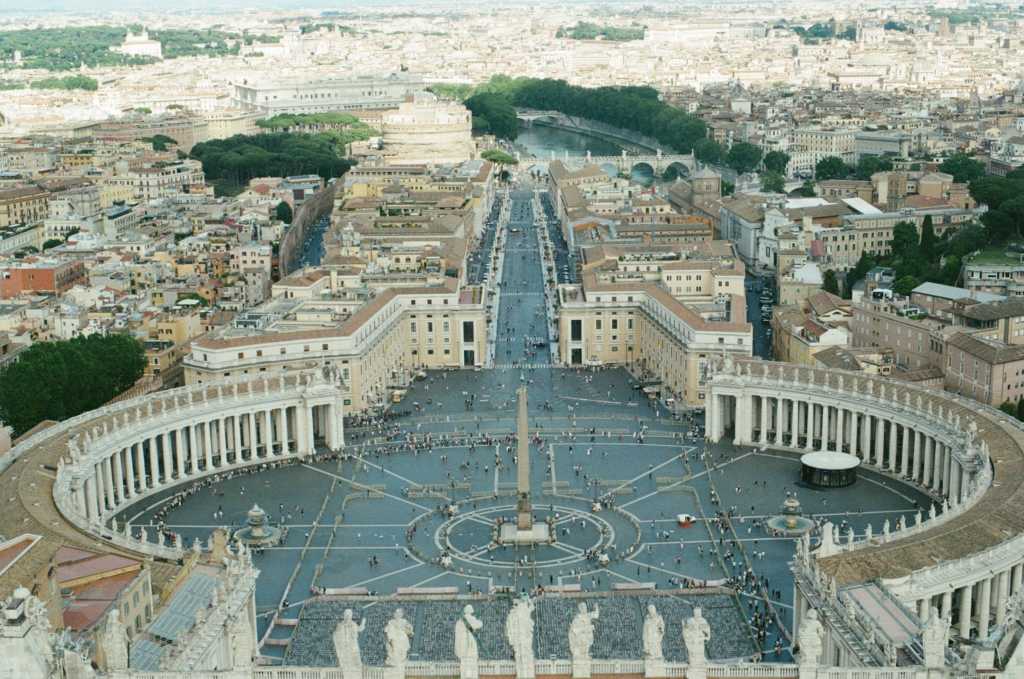
Shot on Pentax K1000 with Kodak UltraMax 400. © Bernz O. Caasi, 2026
The Second Time I Came to Rome
Last May, I returned to Rome and visited Assisi with my mom, my teammates at Hallow App, my Pentax K1000, and a box of color and black-and-white film rolls.
It was my second time in Rome.
The first was after the 2023 World Youth Day — a week with Pope Francis and more than one million young people from all over the world. I saw him a couple of times from afar, in Lisbon and in Manila back in 2015, but never close enough to feel the weight of the moment.
This time was different.
In 2026, about a year after the death of his Argentinian predecessor, I had the chance to see Pope Leo XIV — the first American pope, the 267th pontiff, and the latest successor of St. Peter in a line that has endured for two thousand years.
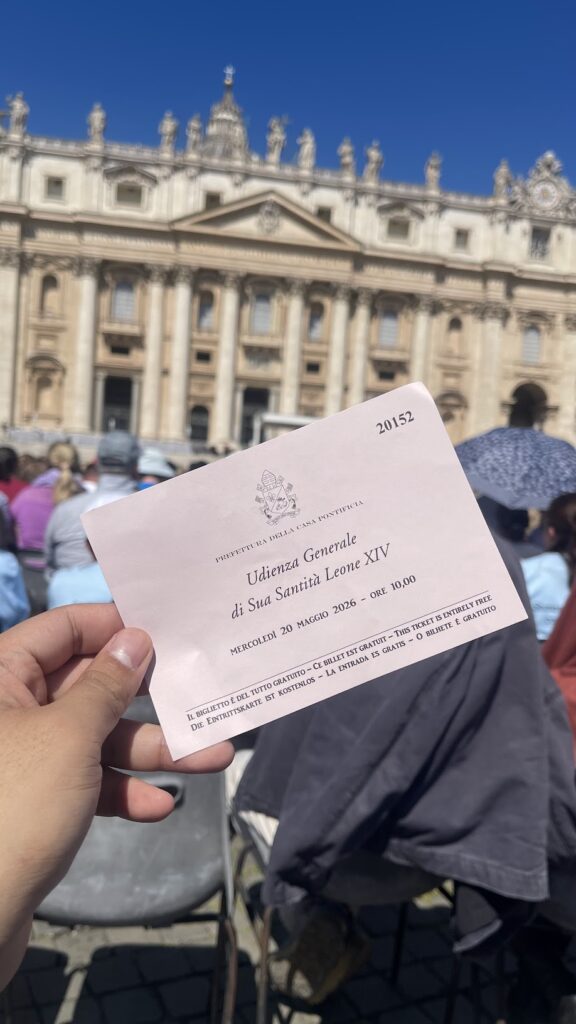
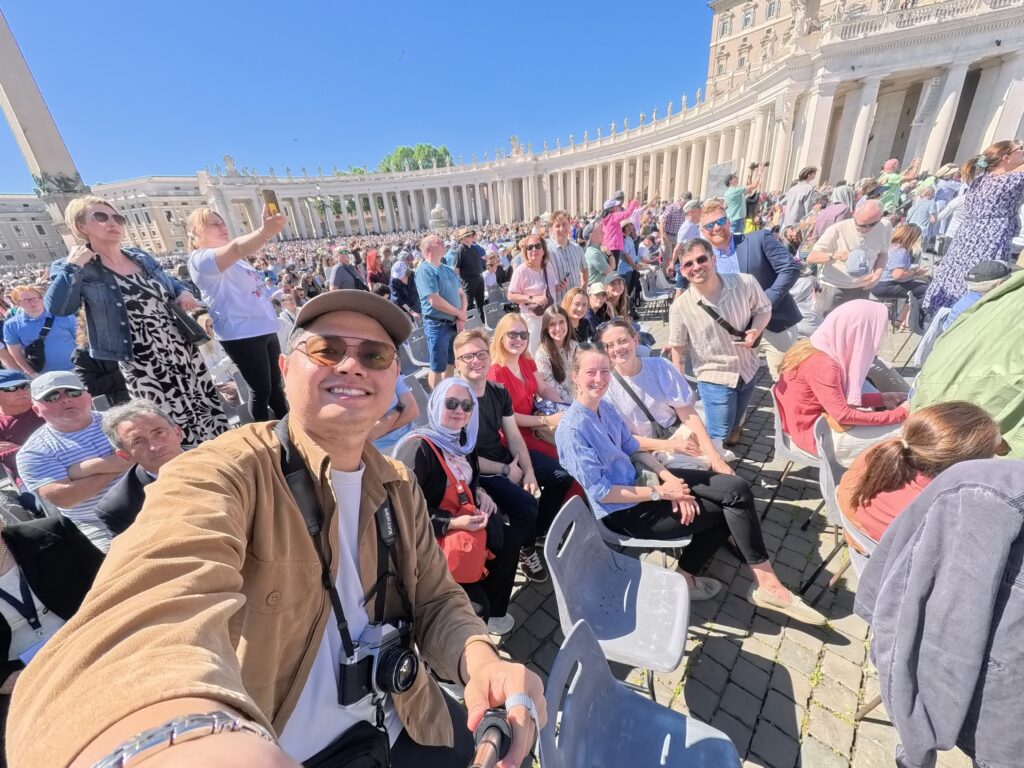
We started queuing for security checks at the Vatican around 8:30 AM to secure a good spot for his 10 AM Wednesday General Audience.
The lines were long, but we made it just in time to stand by the barricade where the popemobile would pass.
How I Set Up My Pentax K1000 to Shoot the Pope
To make sure I’d get to capture the full moment as it unfolded, I brought my Insta360 Go Ultra digital camera with me, but I forgot the magnetic mount I was going to clip onto my cap.
So I had to improvise.
I wrapped Insta360’s magnetic necklace around my head and attached the Go Ultra for a hands-free POV shot.
Problem solved.
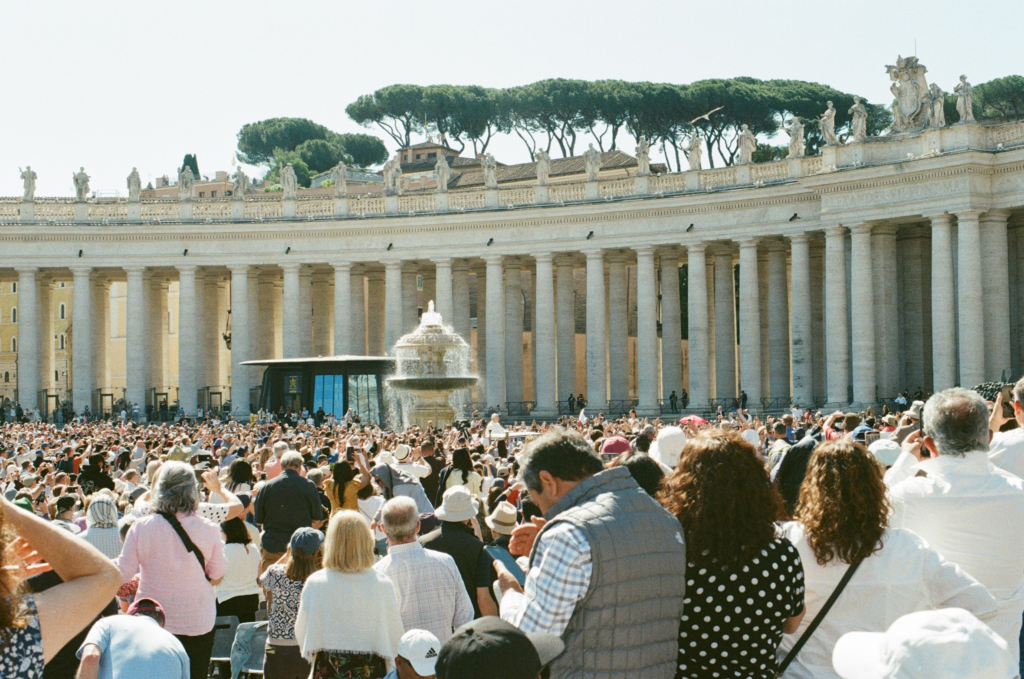
Shot on Pentax K1000 with Kodak UltraMax 400. © Bernz O. Caasi, 2026
Now both of my hands were free for my Pentax camera.
After all, that was my main intention.
To experience the moment with intention and then capture it on film.
I started film photography just seven months ago, and it has quietly become one of the most contemplative things I do. As a Catholic revert, I prayed for the grace to capture this moment with my Pentax K1000, loaded with a roll of Kodak Ultramax 400.
As the popemobile began its rounds around St. Peter’s Square, we could already hear the crowd cheering in waves as the Pope approached. When the excitement around us peaked, I hit record on the Go Ultra — then turned my full attention to the Pentax.
ISO set to box speed 400. Check.
Aperture around f/16 for Vatican’s sunny skies. Check.
Manual focus pre-dialed and estimated for where the Pope would pass. Check.
Shutter speed set to 1/1000 — he would pass quickly. Check.
Film advance lever fully wound, ready to fire. Check.
I thought I was ready.
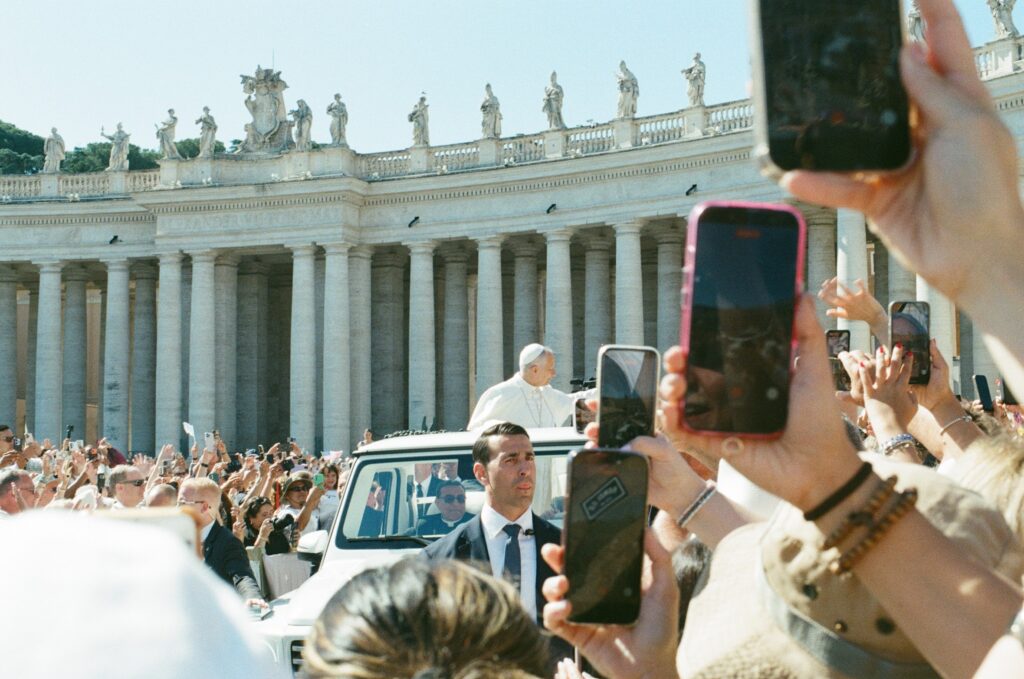
Shot on Pentax K1000 with Kodak UltraMax 400. © Bernz O. Caasi, 2026
The Moment Pope Leo Passed in Front of Me
Then Pope Leo came into view — and stopped.
A baby had caught his attention.
That bought me time.
I raised the Pentax to my eye, looked through the viewfinder, and estimated the manual focus. I adjusted the aperture to what the light meter needle was telling me.
And when he was passing directly in front of me, I looked at him with my eyes first.
I wanted to be fully present in that brief moment.
I was stunned.
For a few seconds, he was not “the Pope” as an idea, or an office, or a theological argument I once rejected.
He was there.
In flesh.
In front of me.
Watch this moment unfold before my eyes:
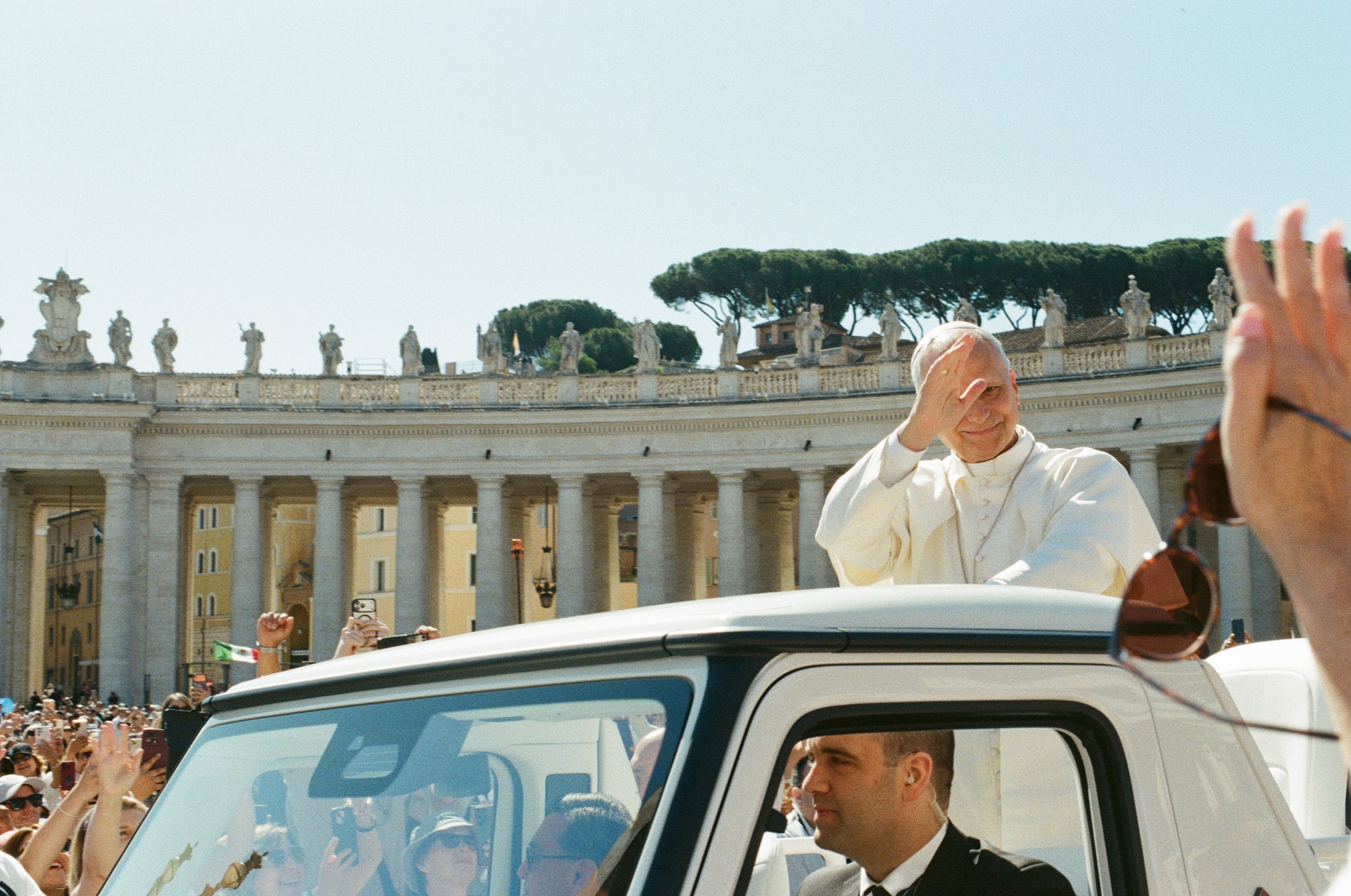
A moment I’ll never forget: Pope Leo XIV passing right in front of us in St. Peter’s Square. You can even hear the sound of my camera shutter. Captured on Insta360 GO Ultra. © Bernz O. Caasi, 2026
Before I saw the successor of Peter through my camera’s viewfinder, I received him first with the lens of my soul.
Then I lifted the camera, quickly adjusted focus, and pressed the shutter.
One shot. Wind.
Another. Wind.
Then another.
No screen to check.
No preview.
No second chance to take a better shot.
I just had to surrender to the shutter and the process.
That’s one of the things I love and fear about film.
You see first. You trust. Then you wait.
All I was certain of was this: there I was, a former Protestant who once called the Pope the Antichrist, cherishing an unrepeatable moment with Pope Leo XIV in the flesh.
It was surreal.
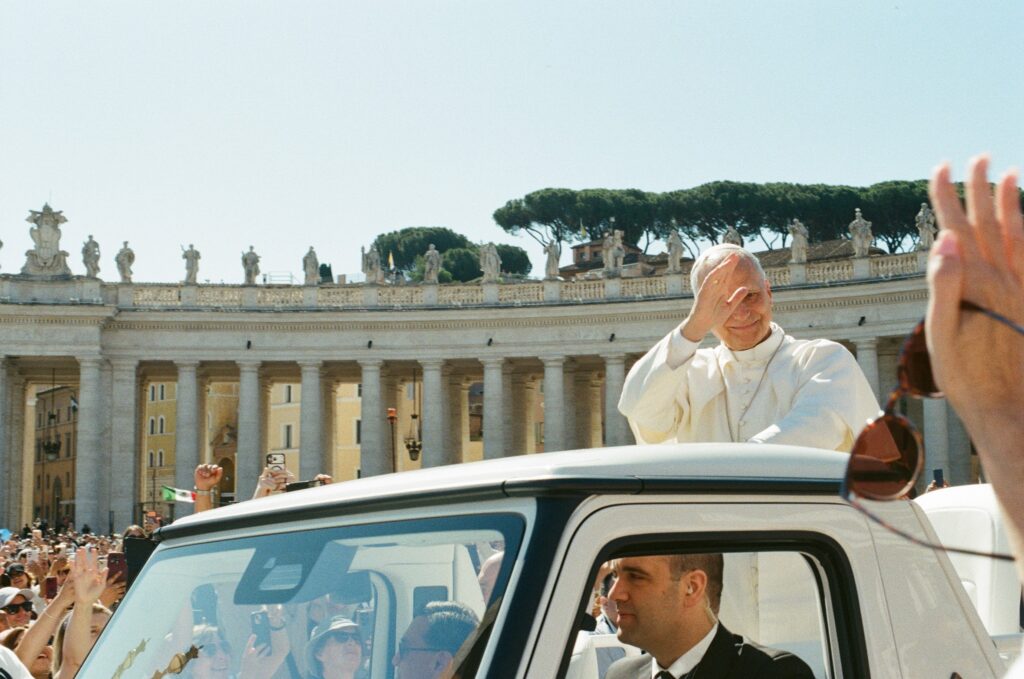
© Bernz O. Caasi, 2026
Why the Papacy Still Stands After 2,000 Years
As he drove farther away from us, many thoughts came to my mind.
I remembered how I once told my mom to burn the statues of the saints.
I remembered how I once told people the papacy was a corruption not found in the Bible.
I remembered how I believed a visionary who claimed the Pope was burning in hell.
Oh, how I misunderstood and judged the Catholic faith with prejudiced eyes.
And now here I was — lifting a lens to capture the face of St. Peter’s successor — filled with a mixture of awe and sadness.
Awe — because 2,000 years after Jesus established His Church, Peter’s office still stands.
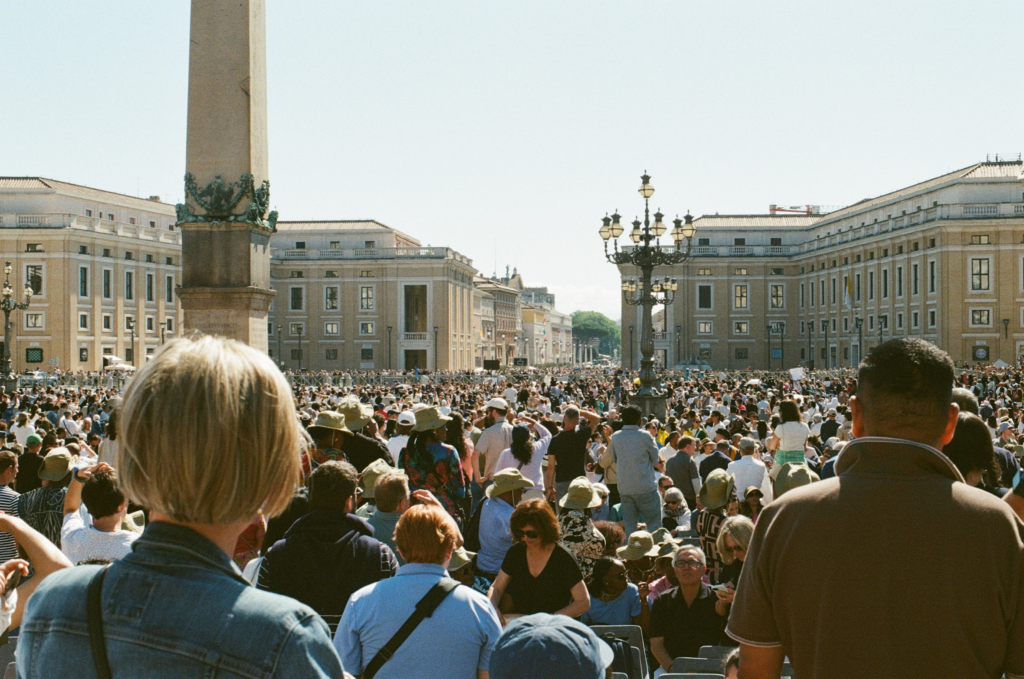
In the Old Testament, the steward of the kingdom is entrusted with the key of the house of David. He opens, and no one shuts. He shuts, and no one opens. In Matthew 16, Jesus echoes that same language from Isaiah 22 — and gives Peter the keys of the Kingdom.
That’s what finally made sense to me as a Catholic.
The Pope is not a replacement for Christ.
Christ is King.
But the Pope is His steward. His “Prime Minister.” The visible holder of the keys until the King returns.
And there he was, right in front of me.
The Holy Roman Empire was once powerful but now remains as museum pieces. Empires have fallen. Ideologies have risen and collapsed. Kings have died and been forgotten.
But the papacy endures.
I had just seen the Pope right in front of me, and I captured a brief moment of Church history unfolding before my Pentax K1000.
But I also felt sadness.
Sadness because, like I once was, many people still misunderstand the office of the Pope and his importance to the Christian faith. I captured his face in my camera and in my heart. And in that same moment, I prayed for the grace to help others see what I now see.
When the Pope finished his rounds and settled into his chair in front of the Basilica, his image appeared on the screen in the square. Behind that screen stood the statue of St. Peter — holding the key.
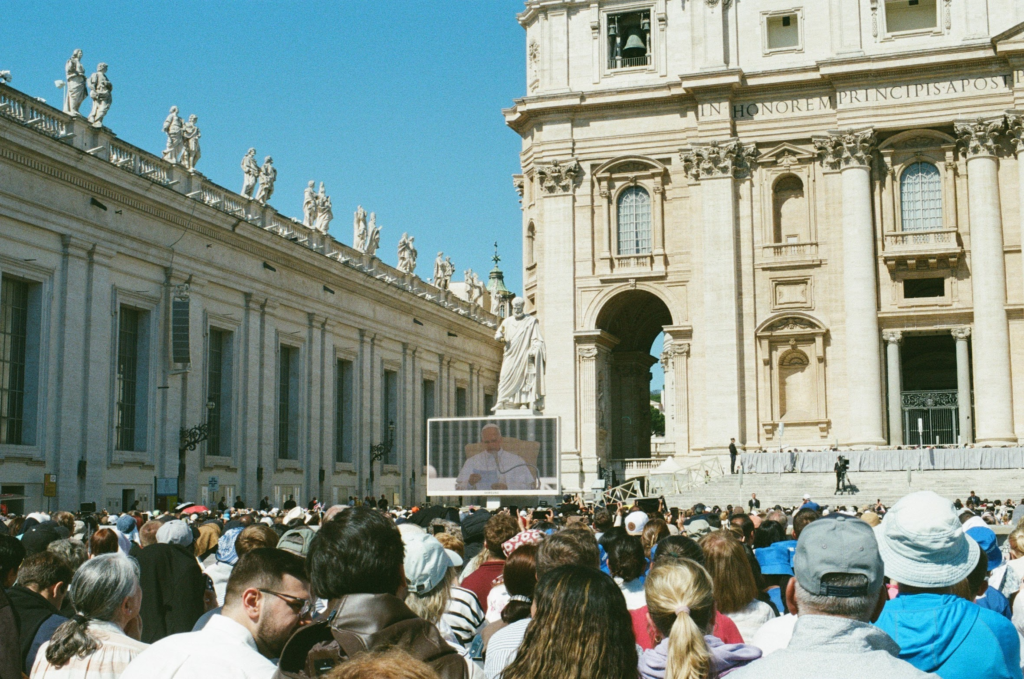
© Bernz O. Caasi, 2026
I didn’t just see a big screen.
I saw past and present held together.
The image of our Church’s enduring legacy and unfolding story.
There he was, the 267th pope, teaching the faithful and pointing us to Jesus, framed beneath the gaze of Peter himself.
“You are Peter, and on this rock I will build my Church.”
God has never left us orphans.
The Holy Spirit continues guiding the Church.
The Pope continues being the Prime Minister of Our Lord.
A Bird, a Window, and the Angelus
On another day, during the Angelus, I took a very different kind of photo.
No popemobile.
No crowd pressing forward.
No quick moment to catch before it passed.
Just the Apostolic Palace rising against a blue sky. The colonnade curving below. The statues of the saints standing watch. And somewhere in that building — in a small window draped in red — a tiny figure, barely visible, speaking to thousands.
And above it all, a single bird in flight.
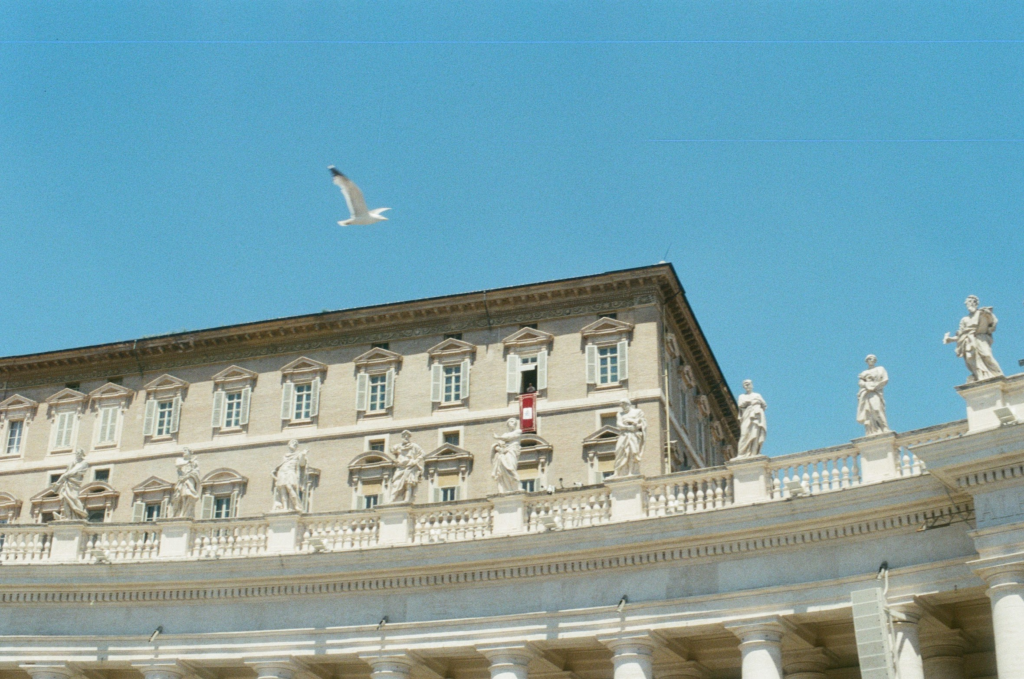
I didn’t plan that frame. Film doesn’t let you plan. You point, you shoot, you trust.
But I think that photo belongs to this story — because the papacy is both near and far.
Sometimes the Pope passes right in front of you.
Sometimes he speaks from a window.
Sometimes you see his face.
Sometimes you only hear his voice.
And sometimes there’s a bird in the frame to remind you that the Holy Spirit still guides the Church.
But either way, Peter is still there.
What the Film Revealed Three Weeks Later
Three weeks later, I developed ten rolls of film from Hong Kong, Rome, and Assisi.
I was nervous.
For someone seven months into film photography, shooting on a fully manual camera in a moving crowd, with limited shots to get it right — I wasn’t sure what I’d find on those negatives.
But grace, apparently, has good timing.
The shot I love most is the one where Pope Leo appears to be looking directly at my camera as he waves. It brought back everything — the closeness I felt in that moment, the stillness inside the noise, the strange intimacy of being one face in thousands and still feeling seen.
He didn’t know I was there.
But the film remembers.
There’s also the back shot — the Pope facing the crowd, arm raised, the colonnade sweeping behind him. That one makes me feel like I’m still there, still in the crowd, still receiving the grace of the moment rather than just documenting it.
And then there’s the wide frame: a sea of smartphones aimed at the Pope, the ancient colonnade rising behind them, pilgrims from every nation crowded together under the same Roman sky.
Ancient stones.
Modern phones.
One Pope.
One Church.
Somewhere in that frame is a person holding a Pentax K1000 — no autofocus, no screen — trusting a roll of film to hold what my heart already contemplated.
I used to call the Pope the Antichrist.
Now I raise my Pentax to remember him as our Holy Father.
And maybe that is the bigger picture God was developing all along.
If you were taught to fear or hate the papacy the way I once did, I hope this story gives you permission to look again — not with panic, not with caricature, but with patience, Scripture, history, and prayer.


Leave a Reply