
This post is solely for the members of the Unboxing Catholicism Community DSR Volunteers. Please don’t share outside our group. 🙂
Hey, Unboxers.
I don’t share this publicly but since you’re family, I will share it here as a reflection on your exchanges in our group chat earlier (July 25, 2021) 🙂
When I returned to the Church after becoming an anti-Catholic Protestant, I knew “what must be done/believed in” because of the formation I didn’t deserve but nonetheless I have received from my friends who painstakingly accompanied me in my faith journey.
Because I had the vision of “ideal practice of the faith”, I struggled making sense of two things that scandalized me as a revert/convert:
- Catholics – lay or ordained – criticizing each other online.
- Priests not preaching about the sacraments of confession and the Eucharist on their homilies.
Scandalized by divisions.
For #1, I was shocked because one of the things that made me Catholic is the “certainty of the faith” given to us by the Scriptures and Tradition AUTHORITATIVELY (not authoritarian) interpreted by the Living Magisterium of the Church.
As a Protestant back then, I had friends who chose which “Christian teachings” they would follow because they feel like it’s good for them.
I thought that Christianity was a menu that I could customize according to my own preferences.
I don’t have space here to geek out on what I realized in #1, but I thought back then that IF I HAD met Catholics who are always on the mode of “finding faults” and “criticizing others,” PERHAPS I WOULD HAVE RECONSIDERED becoming a Catholic again.
My thinking was very simple: “Kung ganun rin pala ang mga Katoliko sa loob ng Simbahan nila – nag-aaway at hindi nirerespeto ang Santo Papa nila, bakit pa ako magiging Katoliko? Anong kinaiba ng pinapakita nila at pag-iisip nila sa mga Protestante?”
My thinking was very simple: “Kung ganun rin pala ang mga Katoliko sa loob ng Simbahan nila – nag-aaway at hindi nirerespeto ang Santo Papa nila, bakit pa ako magiging Katoliko? Anong kinaiba ng pinapakita nila at pag-iisip nila sa mga Protestante?”
I saw how that bad example could make it more difficult for non-Catholics like I was to see the beauty of the faith beyond the issues. A Protestant friend just said: “Kayo-kayo mismong Katoliko nag-aaway eh. Ano mapapala ko kung makikigulo pa ako?”
Case closed. He was already not willing to listen in the dialogue.
Napaisip ako kung ilan pa katulad niya na ganun rin ang iniisip. .
Eventually, nasanay na rin ako, and I realized that even though the Bible (both Old and New Testament) taught the primacy of Church authority, guided by the Holy Spirit, as the final arbiter of religious truths and practices, there will be Catholics who will oppose because of human freedom and different degrees of formation/discernment.
I also learned to recognize their positive intent – that’s to point out what could be better in the Church. They simply react to issues as activists would react to political errors of the government.
But then I also realized after a while that the Church is not supposed to be seen only through the lens of politics and secular government.
It’s more special than that. It’s more divine than that.
It’s a FAMILY that God redeemed with His very blood.
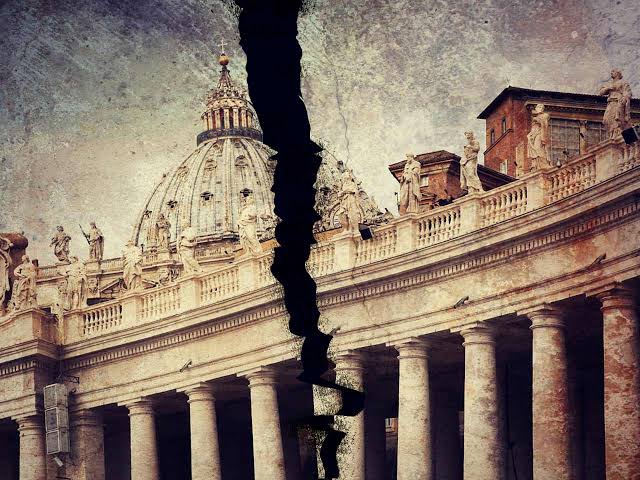
It’s HIS BODY that we’re TEARING APART when we quarrel with one another.
It’s HIS FACE that we tarnish when we don’t give good example.
Until now I am deeply saddened that we are a family so divided, always washing our dirty linens in public.
Imagine posting on social media your issues with your mom, dad, and your siblings.
Does that feel right? What would other people from other families think?
Whatever happened to John 17:20-22? Are we willing to die for that?
The Devil is so happy for after all, “diabolos” means “to divide,” “to separate,” “to throw against.”
You know what’s ironic, I feel into the same temptation that I’ve described in #1!
I tremble whenever I meditate on Matthew 12:22-28. I hope you can pray about this passage and see it happening in the Church today.
The religious people accused the Lord for being that of the Devil. Notice what the Lord said, knowing what was in their hearts.
Let us guard our hearts. It’s the citadel of our interior life.
Scandalized by the priests.
For #2, there was a long period of time that I would be really really mad and sad to the point of breaking down whenever a priest would not take advantage of “teaching moments” that the readings of the Mass could have given him.
Example: there was one time when the Gospel was John 20 – about confession.
The priest gave a homily with a totally unrelated angle/story to the essence of the gospel.
When he finally said that “we must repent,” I thought he would already mention “confession” because as far as our Catechism is concerned, that’s the concrete application of contrition.
When the Mass ended, he said “Uy may nakalimutan ako.”
I thought he will finally mention the “how” of returning to the Lord, however, he said: “Sana makabili po kayo ng kalendaryong binibenta sa patio ng Simbahan.”
I went home that night, complaining to my mom, complaining to my mentors, complaining to my friends – my spiritual directors. I was at the verge of posting long rants on social media.
I opened Word and drafted “An Open Letter to the Filipino Priests – from a Former Protestant.”
I started writing all the faults I could find and all the missed opportunities these priests could have had IF THEY ONLY preached well.
I was so mad. So furious that I really wanted to publish it and even print it and give it to all diocesan priests I knew.
Until I realized that I let my anger got the best of me.
I forgot to pray.
I forgot to ask our Lord what He would have done if he were in my position.
I also realized how arrogant I was that I only saw the mistakes of the priests, but I didn’t take into consideration the other good things he has done for their parish (not my parish).
I saw the log in someone else’s eyes without seeing my own.
I realized that during that Mass, instead of allowing the Lord to heal me and enlighten me, I was like that Pharisee praying: “Buti pa ako walang kasalanan.”
Instead of “waiting on the Lord,” I was waiting for the priest to commit more mistakes – this time in his bowing, genuflecting, pronunciation, everything!
The Conversation that Converted Me (Again)
I cringed at how self-righteous I was, and I started contacting my friends to ask for guidance on how I should process my experience.
One of my mentors told me, “Instead of publicly criticizing priests who don’t teach about confession, why don’t you pray to our Lord for opportunities to allow you to share with people the beauty of confession – share about parishes that have regular confessions. Feature them. Help the priests see what they could be doing. Encourage people to learn about the Sacraments.”
He then told me of the silent apostolate being done by the Members of the Priestly Society of the Holy Cross.
I was encouraged to see another way of addressing my concerns.
That conversation led me to a deeper conversion.
It was one of the things which led me to really seek how to defend the faith clearly without being preachy.
At first I was not satisfied with it. I wanted a quick-fix solution.
Yung tipong next week pagpunta ko sa Church, mapapasabi ako: “Mabuti, natuto rin si father.” (Cringe!!!)
But then again, I had to struggle in rectifying my intentions. Pride is a huge enemy to our progress in the spiritual life. St. Josemaria urged us to always have that in check without becoming paranoid or scrupulous.
Instead of publishing the “Open Letter,” I made it a point to befriend our priests in whatever ways I could.
These encounters led me to eventually telling them of my frustrations about confession.
I told my parish priest and others of the same thing, and ironically my parish priest even asked me to give a talk in the parish where I shared about confession.
Some of them have apologized on behalf of their brother priests, informing me that they thought “people already knew what to do.”
I realized how limited my view was. I was judging the priests from what I know the books were teaching, but I didn’t give myself a chance to encounter them where they were – to dialogue with them and see their own worries and concerns.
I cage them in the limitations I have mentally created for them.
I am not excusing them.
I am just sharing on my realizations on a third way we could discern.
Way # 1: Be silent and ignore all the problems of the Church and sing kumbaya.
Way # 2: Chastise all the erring Catholics in public as if we’re the most perfect saints on earth.
Way # 3: Recognize our own need for grace/conversion while helping the Church one soul at a time, all dependent on His grace – doing it not because we are the best and the strongest, but precisely it is because we are weak and in building up others we acquire the grace of strenght – the perseverance of the saints.
I understand that for many learned Catholics, issues on the liturgy are trigger-worthy and disheartening.
It is my prayer that we can all have the courage and humility to ask our Lord: “which way do you want me to go?”
You don’t have to have the answers today.
The more important thing is you’ve started discerning now.

Leave a Reply