
Author: Bernz Ordoñez Caasi

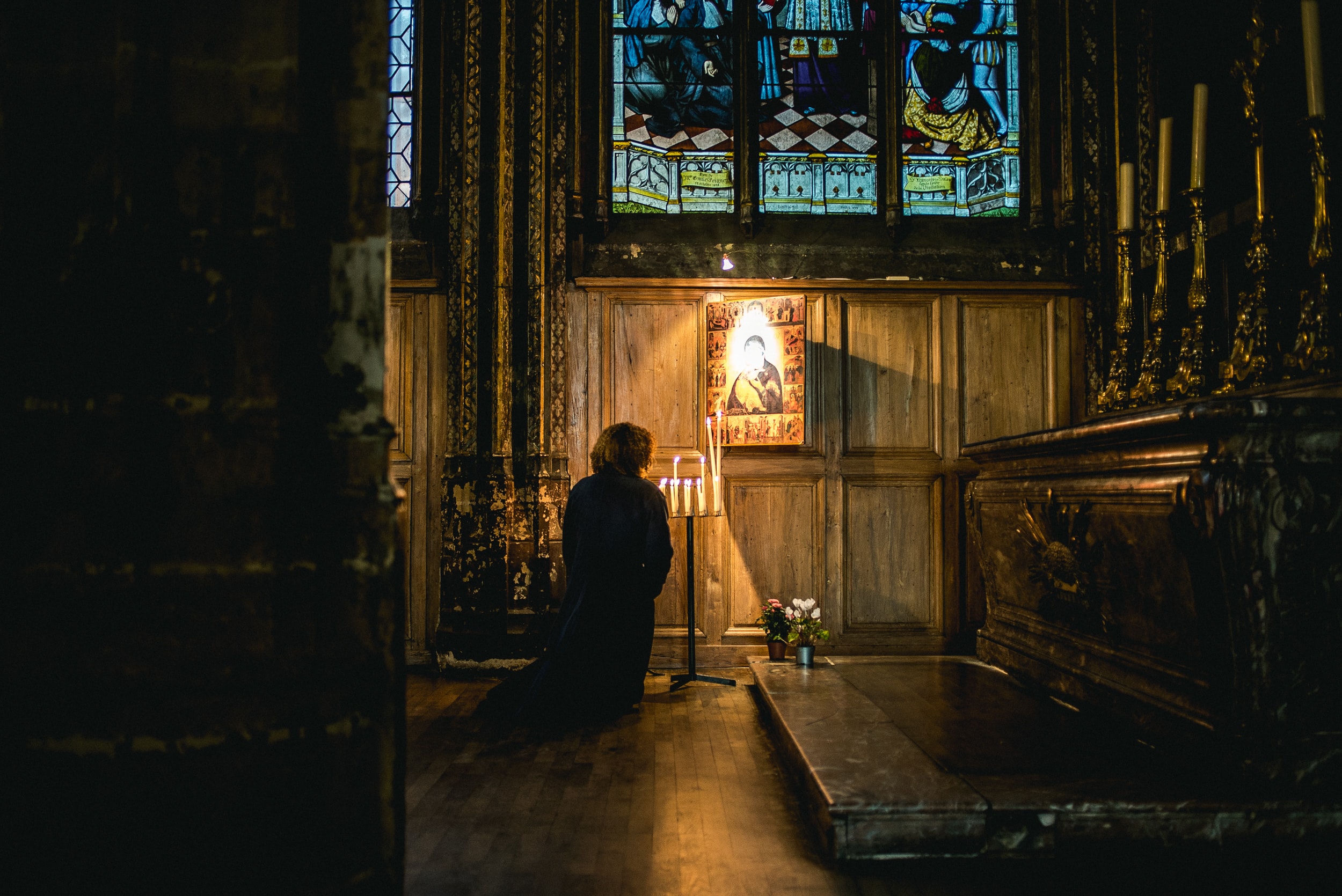
  • Why pray to saints and angels if we could just talk to Jesus?

    Why pray to saints and angels if we could just talk to Jesus?

    Being a former Protestant who denounced Catholics for praying to the saints, I completely understood where my evangelical student was coming from. Back then, I even told my mom to burn the statues of the saints! 

    Now that I have grown deeper in my faith as a Catholic, I’d like to offer three points for us to consider:

    Isn’t Christ the ONLY mediator?

    In his letter to Timothy, the Apostle Paul told his young disciple: “For there is one God; there is also one mediator between God and humankind, Christ Jesus, himself human, who gave himself a ransom for all (1 Timothy 2:5-6).”

    Yes, ultimately Jesus is the one mediator of our salvation. It is through his death that we are saved. No other human being – even a saint – can claim that.

    HOWEVER, Christ’s being one mediator did not prohibit us from “mediating – or interceding – for one another.” In fact, St. Paul urges us to do just the opposite! Look at what he told Timothy just two verses earlier in his letter:
    “I urge that supplications, prayers, intercessions, and thanksgivings should be made for everyone… this is right and acceptable in the sight of God our Savior…” (1 Timothy 2:1-3).

    The Greek word for “intercession” is “enteuxeis” which means to “go between or petition for one another.” Therefore, since Christ is our one mediator, he is calling us to participate in his mediation through our prayers and intercessions. 

    The argument “why don’t you just go directly to God” then loses its meaning. In fact, Christians – Catholic or not – always ask for mediation when they say, “Please pray for me.” Should we then ask, “Why do you ask your friends and your pastors to pray for you if you could just go directly to God?”

    Can the saints and angels answer our prayers?
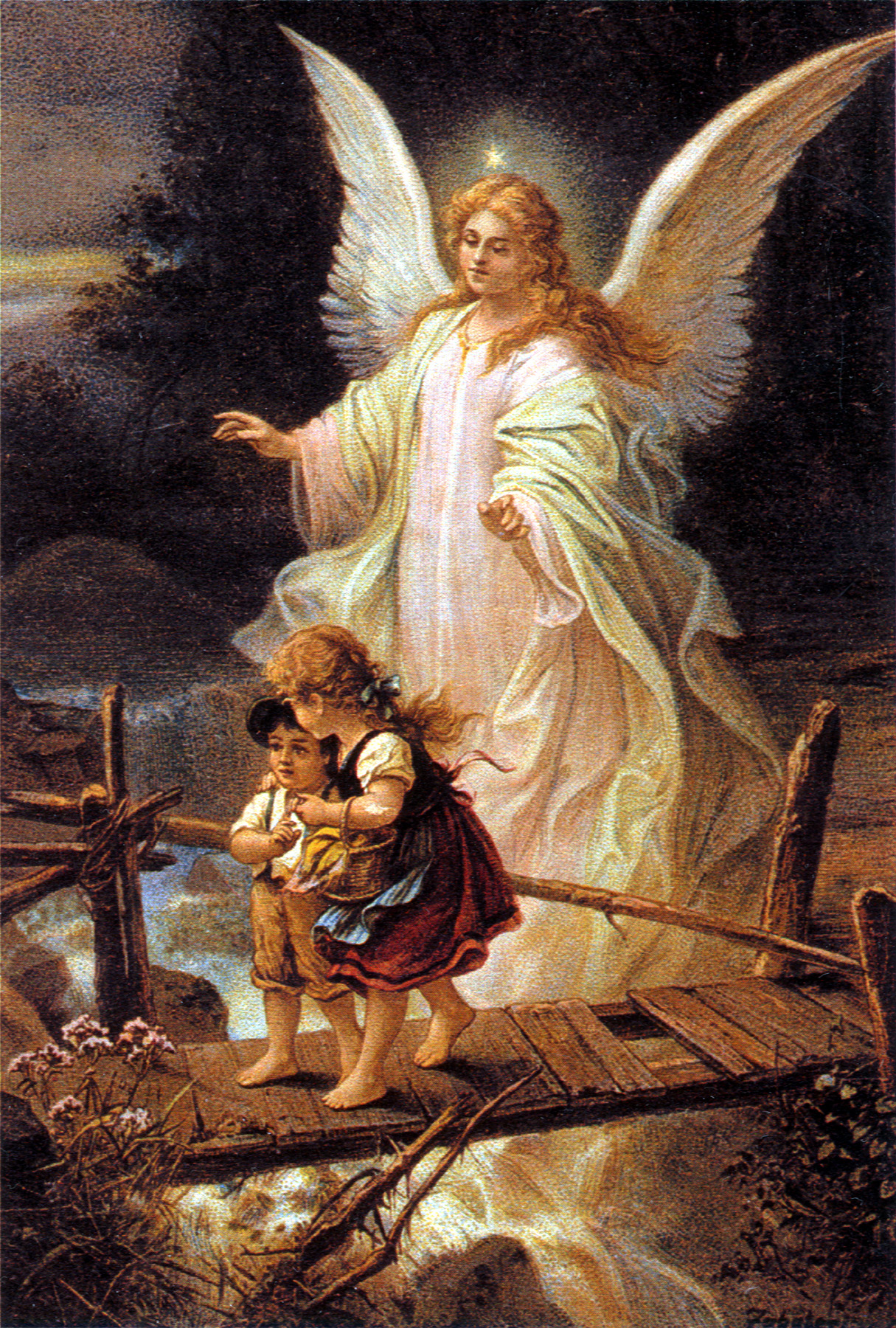
    While many Evangelicals misunderstand our prayer to saints as acts of worshipping them, no one would accuse me of worshipping my relatives by asking for their prayers. And this is what Catholics really do when we invoke the saints. 

    Notice that we never directed to the Blessed Virgin Mary, the angels or the saints phrases like “we adore you” or “we worship you.” It has always been “Pray for us” or “Intercede for us.” We don’t pray to saints expecting them to give us the answer to our prayers. Ultimately, it is God who grants our petitions. Rather, we ask them to pray with us and for us.

    As St. James said in his letter, “The prayer of the righteous is powerful and effective” (James 5:16). If we believe that the prayers of the sinners here on earth can help us, how much more the prayers of those who are already in Heaven?”

    Can the saints and angels in heaven hear us?

    As I explained these things to my student, his eyes lit up. And just as I expected it, he asked me the clincher question – do the saints in heaven really pray for us?

    When I was still a Protestant, my pastor told me that the so-called “saints” are dead and they will never hear our prayers nor know what we do. However, soon I realized that it’s not what the Bible was teaching. It shows us that the saints and angels in heaven are alive and interceding for us.

    In Luke 9:28-36, Jesus talked to Moses and Elijah during His transfiguration. Did Jesus, a faithful Jewish, violate teaching against talking to the dead (Deuteronomy 18:10-13)? No. Moses and Elijah are alive in heaven. In Luke 16:19-21, we also see Christ teaching the parable of the rich man and Lazarus. Upon his death, the angels brought Lazarus to the side of “Father Abraham” and he comforted the poor man, knowing very well how much he suffered on earth. We also know that all the heavens are aware and rejoice when one sinner repents and goes back to Christ (Luke 15:7)!

    What’s even more striking is this: in the bible, we see the saints in heaven offering our prayers to God in the form of bowls of incense (Revelations 5:8; Psalm 141:2). Look at how detailed the description of their intercession is:

    Then another angel, having a golden censer, came and stood at the altar. He was given much incense, that he should offer it with the prayers of all the saints upon the golden altar which was before the throne. And the smoke of the incense, with the prayers of the saints, ascended before God from the angel’s hand. Then the angel took the censer, filled it with fire from the altar, and threw it to the earth. And there were noises, thunderings, lightnings, and an earthquake.

    Revelations 8:3-5, NKJV – a Protestant translation

    We have friends in heaven

    I would never forget that conversation I had with my student. I do hope and pray that he’ll realize how much God has blessed us with so much help from heaven. 

    As Christians, we have been blessed to have a Mother who intercedes for us (John 2:3), angels who accompany us (Hebrew 1:14; Matthew 18:10), and a great cloud of witnesses – saints – who urge us to follow our Lord and Savior Jesus more faithfully (Hebrews 11-12:2).

    Just as we give honor to the artist when we praise his works, we give so much honor to God when we praise His creation – especially his saints, our friends from Heaven, His gifts for us.

    May we have a close relationship with our angel and the saints that we too may worship God with them once we reach the glory of Heaven.
  • Why I Thought Catholics are Cannibals

    Why I Thought Catholics are Cannibals

    [et_pb_section fb_built=”1″ admin_label=”section” _builder_version=”3.22″][et_pb_row admin_label=”row” _builder_version=”3.25″ background_size=”initial” background_position=”top_left” background_repeat=”repeat”][et_pb_column type=”4_4″ _builder_version=”3.25″ custom_padding=”|||” custom_padding__hover=”|||”][et_pb_text admin_label=”Text” _builder_version=”3.27.4″ background_size=”initial” background_position=”top_left” background_repeat=”repeat”]

    When I told an evangelical friend that I was thinking of becoming a Catholic again, he couldn’t believe what he heard and thought I’d be joining a cannibalistic cult.

    “Didn’t you know that they are cannibals since they profess to eat the body of Jesus and drink his blood? Yikes.”

    I didn’t know how to answer the question for I myself wasn’t convinced yet that Catholics got it right about the Eucharist. Through years of study, prayer, and reflection I have already realized how Catholic theology made sense in terms of salvation, authority, confession, praying to saints, etc. but the belief that Jesus is actually eaten was not so easy for me to chew on.

    I realized that I wasn’t alone. Roman pagans accused early Christians of cannibalism because the disciples of Christ spoke of eating the real body, blood, soul, and divinity of our Lord during Communion in the Mass.

    In the first part of this series on the Eucharist, I would like to share with you the points of reflection I’ve had during my own spiritual journey. Let’s begin with the Scriptures, the written Word of God.

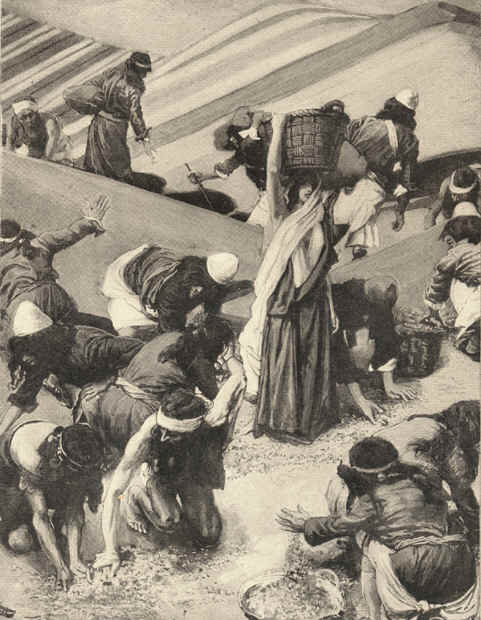
    Manna from heaven

    In the Bible, when Jesus talks about eating Himself, He says it so plainly and intensely that His Jewish audience – and even disciples – are disgusted and scandalized. Let’s take a close look at John 6.

    After the Lord fed five thousand people with five barley loaves and two fish, the people sought him and asked Him for a sign to know how they should believe in Him. Jesus reminded them that they shouldn’t be working for the food that perishes but for the food which He would give that endures to eternal life.

    And here’s where the interesting exchange started.

    The Jews said that their ancestors ate the manna – bread from heaven –  while they were in the wilderness. Jesus responded by saying that their fathers ate manna and now are dead but His Father will give them the bread of God which comes down from Heaven and gives life to the world.

    Intrigued, the Jews said, “Lord, give us this bread always.”

    Perhaps they were still thinking of the bread they ate just the day before. Jesus surprised them with what he said next: “I am the bread of life; he who comes to me shall not hunger, and he who believes in me shall never thirst.”

    That is where they first murmured and doubted. How can he come from heaven if he was just the son of Mary and Joseph?

    Wasn’t he the carpenter who fixed their broken dining table?

    Was he the one some of them were playing with when they were young?

    The Jews were shocked!

    Jesus implored them to believe and said something even more shocking: “…the bread which I shall give for the life of the world is My flesh” (verse 51).

    You could just imagine how the Jews disputed and questioned the sanity of the man they called “rabbi” after hearing that. The scriptures record how scandalized the Jews were and asked among themselves how can Jesus give them His flesh to eat.

    However, Jesus didn’t say, “Wait a minute, you didn’t get my metaphor. Here’s what I meant…” No, in fact, he emphasized what he meant even more.

    The Lord said in verse 53 and following, “Truly, truly, I say to you, unless you eat the flesh of the Son of man and drink his blood, you have no life in you; he who eats my flesh and drinks my blood has eternal life…for my flesh is food indeed, and my blood is drink indeed. He who eats my flesh and drinks my blood abides in me, and I in him.”

    Jesus clearly -and repeatedly- said that for men to have eternal life, we should eat his flesh and drink his blood. What’s even more interesting here was how Jesus shifted the verb he used when he said: “eats my flesh” in verse 54.

    In the first part of John 6 where he was making references to eating, the word used in Greek translation was “phago”, an all-encompassing term for eating which can be literal or figurative. However, when He was referring to Himself, the word used is “trogon” which specifically means “gnawing” and “chewing.”

    The Jews couldn’t take what the Lord was teaching them for they knew what He meant – they knew what trogon means. Even his disciples thought that it was such a “hard saying” that they couldn’t listen to.

    Jesus knew that they were offended and told them that understanding the matter with the flesh or pure human capacity would be futile for what he said are of the spirit. Still, many of His disciples left him.

    Peter’s confession – and ours, too.

    Jesus asked the apostles, “Do you also wish to go away?”

    Perhaps the apostles were also having a hard time processing what they’ve heard – I mean, who wouldn’t? Imagine your teacher telling you to eat him while in class? Yuck.

    But Christ was different. He was not just a teacher in a classroom.

    He multiplied the bread and fish to feed five thousand.

    He healed the sick and converted many souls.

    He walked on the water. He ordered the winds to stop blowing.

    He raised Lazarus from the dead. He rose from the dead.

    And when he told the Jews that He is the bread of life which they have to eat, they couldn’t believe in Him – so what will convince them? What will convince us?

    Peter said it plainly and beautifully in verse 69, “Lord, to whom shall we go? You have the words of eternal life; and we have believed, and have come to know, that you are the Holy One of God.”

    The apostles chose to believe and waited to be enlightened by the Lord. Exactly one year after that episode, the apostles were gathered for the Passover meal but there was something missing – there was no sacrificial lamb! Then this is what happened…

    While they were eating, Jesus took bread, and when he had given thanks, he broke it and gave it to his disciples, saying, “Take and eat; this is my body.”

    Then he took a cup, and when he had given thanks, he gave it to them, saying, “Drink from it, all of you. This is my blood of the covenant, which is poured out for many for the forgiveness of sins…” (Matthew 26:26-27)

    What could be simpler than that?

    Jesus didn’t say, “this looks like My body,” “this is like My body,” or “this is a symbol of My body.”

    No. He simply said, “this is My body”… “this is My blood.”

    Finally, the apostles understood what he meant a year ago. Do you think Peter understood everything the Lord told the Jews? Probably not. Perhaps he and the apostles kept on thinking about it for a long time, but he and the apostles remained faithful.

    It was like the first pope was saying, “Lord, we don’t understand everything You have said, but we know You are our everything. It is hard, but by faith, we believe in you.”

    Now many popes and more than two thousand years ago have already passed, we tell our Lord every time we receive Him in Communion – “Lord, to whom shall we go? You are the Holy One of God. You are our God, and you are my everything. Thank you for giving us your all – your body, blood, soul, and divinity.”

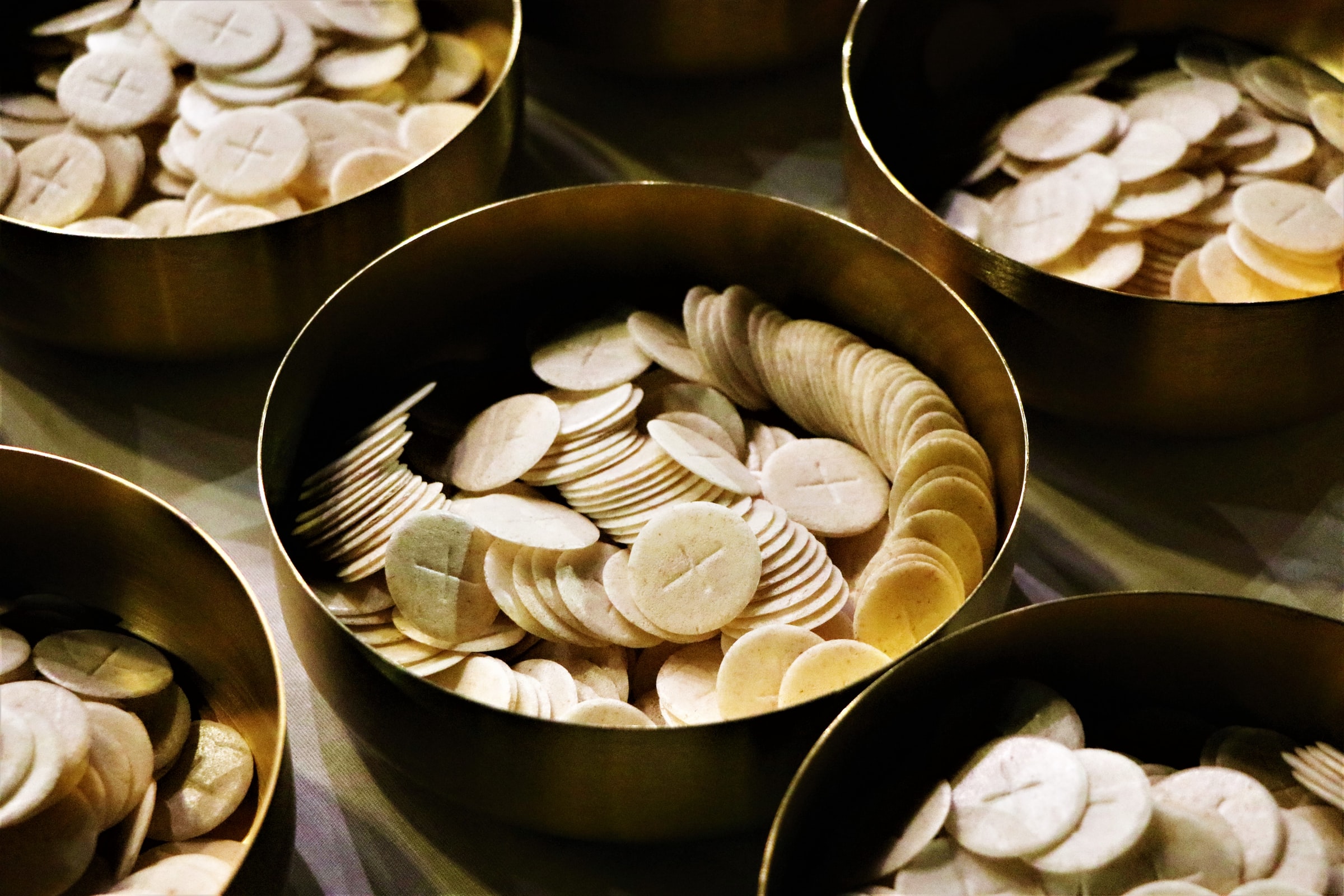
    It is my prayer that when you receive the Eucharist, you’d realize that it is not a simple wafer but the Lord Himself. He’s been waiting for you. He wants to feed your soul and nourish you. He is the bread of life.

    Receive Him more often, and your life will never be the same.

    In the next two parts of this series, we will examine how the early Christians understood John 6 and why it makes so much sense for the Lord to feed us with His flesh.

    What do you think of this post? Please share your thoughts below and don’t forget to subscribe to read the next parts ahead of everyone else.

    Happy Feast Day of Corpus Christi!

    Featured photo by James Coleman on Unsplash. Other photos from Google Photos.

    [/et_pb_text][/et_pb_column][/et_pb_row][/et_pb_section]
  • What can an apple teach us about the Mystery of the Trinity?

    What can an apple teach us about the Mystery of the Trinity?

    [et_pb_section fb_built=”1″ admin_label=”section” _builder_version=”3.22″][et_pb_row admin_label=”row” _builder_version=”3.25″ background_size=”initial” background_position=”top_left” background_repeat=”repeat”][et_pb_column type=”4_4″ _builder_version=”3.25″ custom_padding=”|||” custom_padding__hover=”|||”][et_pb_text admin_label=”Text” _builder_version=”3.27.4″ background_size=”initial” background_position=”top_left” background_repeat=”repeat”]

    After class, a student asked me, “Sir, was God lonely that’s why He created the world from nothing?”

    I responded by asking him why he would think God was lonely. As he was trying to think of his answer, some of his classmates started listening to our exchange. My student finally said, “Perhaps because God was alone?”

    I told the boys, “Well, gentlemen, God is one – but He is not alone.

    If you are thinking, how come? Let’s read on.

    Reason and revelation tell us that He is one.

    Christians – whether Catholic or not – profess that there is only one God and this is rightly so for the Bible teaches us that. Read Deuteronomy 6:4 and Isaiah 45:21 among other scriptural passages. Common sense also will tell us that since the meaning of “God” is all powerful, all present, all good, and all knowing, it is logical to say that the one who possesses the fullness and completeness of all those attributes should be one.

    Now, if that is the case, how come He is not alone?

    He is a Trinity

    Because God is a very happy family of three persons. He is a community. He is a Trinity.

    God has revealed to us who He is – Father, Son, Holy Spirit (Matthew 28:19-20). Therefore, even before creation began, God was one but not alone. He is one God in three persons (1 John 5:7-8).

    The Father and the Son love each other eternally and that Love which is so strong is the person of the Holy Spirit. This is also the reason why God is truly Love itself (1 John 4:7-8). In Him exists the Lover, the Loved, and the Love between the two.

    That love made God immensely blessed beyond anything and anyone that is why He created the world to share and show His love and blessedness. Through the Holy Spirit, we experience the immense love, mercy, and compassion of God.

    Analogies can help us visualize the Trinity

    Now, what does the apple have to do with this?

    Since the Trinity is the highest of all Christian teachings and mysteries (when used in theology, mystery doesn’t mean “mythical” or “mysterious” – it means something that reason alone cannot fully grasp), it would help to use some analogies to explain this better. The analogies are not perfect as God cannot be fully and completely comprehended in all of His glory, but these illustrations are helpful.

    The Triangle

    The classic analogy I learned from my college theology class was the triangle. The three distinct sides are in one triangle – just as the Father, the Son, and the Holy Spirit are different persons in one God – and each of them is fully God and not just parts of God. Being different, they also have different but equally important roles – the Father is the Creator, the Son is the Savior, and the Holy Spirit is the Sanctifier. More on this concept in future articles.

    I understand that this can be confusing, but again, this is an imperfect analogy.

    The Fire

    My ethics professor also told us that the Trinity can also be explained by looking at the fire. The fire itself has heat and light. In a similar way, we could say that God is fire itself (Father) and the light is God the Son (Jesus is the light of the world) and the Holy Spirit is the heat (the warmth of God’s love).

    The Apple

    Finally, I recently learned from this blog that an apple can somehow represent (although again, imperfectly) the Trinity. The apple fruit has three parts – the skin, the flesh, and the seeds. The Father can be likened to the skin which protects, the Son can be seen through the flesh since Christ became human (flesh) and the Holy Spirit is the seed because it makes us grow deeper in our Christian faith.

    What now?

    Today, June 16, is the Solemnity of the Most Holy Trinity. Let us spend time reflecting on this great teaching of our Faith and immerse ourselves in a loving conversation with the Father, the Son, and the Holy Spirit through prayer and reflection, most especially during the Holy Mass.

    May we resolve to do the Sign of the Cross more reverently, remembering the trinity of love in which we are called to participate, and knowing that through that simple gesture we declare that we are sons and daughters of our Almighty God.

    We only have one life to learn about our faith so we can best know, love, and serve God. Let’s read the Bible and study the teachings of Christ through the Church that He built. Your life will never be the same – it’s all worth it.

    Do you have better ways to explain the Trinity? Let us know through the comments below.

    [/et_pb_text][/et_pb_column][/et_pb_row][/et_pb_section]
  • Why the Body of Jesus remains on the Catholic Cross?

    Why the Body of Jesus remains on the Catholic Cross?

    [et_pb_section fb_built=”1″ admin_label=”section” _builder_version=”3.22″][et_pb_row admin_label=”row” _builder_version=”3.25″ background_size=”initial” background_position=”top_left” background_repeat=”repeat”][et_pb_column type=”4_4″ _builder_version=”3.25″ custom_padding=”|||” custom_padding__hover=”|||”][et_pb_text admin_label=”Text” _builder_version=”3.27.4″ background_size=”initial” background_position=”top_left” background_repeat=”repeat” custom_padding=”||0px|||”]

    As a Protestant before, I was told that Catholics crucify Jesus again and again since his body is still on the crucifix even He had already risen to Heaven. For this reason, non-Catholic Christian communities have crosses in their churches, but you would never see the “corpus” or the representation of Christ’s body on it.

    When I entered college, things started turning out differently. Through the silent and faithful witness of many Catholics in my University and my study of the Church’s teaching and history, I slowly regained
    my respect for Catholics and gradually realized how its teachings are sensible and most of all, true and biblical.

    I want to share with you three points that we could pray about.

    The meaning of the cross

    Death, punishment, darkness, damnation – those are just a few words that one would associate with the crucifixion, the most  excruciating punishment for the worst criminals in the ancient Roman world. Isn’t
    it ironic that it would also be Christianity’s greatest symbol of Life, Liberation, and Love?

    How come this cursed wood brings a message to humanity today that is very far from how the ancient world viewed it? The reason lies in one man, the greatest one who was ever tormented on that tree –
    the God-man Himself, Jesus Christ.

    The Lord was not the first and only one to experience the pains of that morbid execution. He was not the first and only one who was humiliated with indescribable nakedness and defilement, but among
    the thousands who have been nailed on that wood, Christ was the first one who changed how the cross will be seen by humanity forever. Through His death, we find life. Through His sufferings, we find peace. And indeed, as it was written, “he was wounded for our transgressions, he was bruised for our
    iniquities: the chastisement of our peace was upon him, and with his stripes, we are healed” (Isaiah 53:5).

    The nails that drove through the hands of our Savior didn’t mean pain anymore, but a freedom from the prison of sin. The wood that was stained by the innocent blood of the Lamb ceased to speak of
    unutterable hate and sorrow but only of love and eternal joy. When for hundreds of years the cross was the gateway to death, on Good Friday, Christ made it the Door to Life-a passageway to Heaven that united once again man to the Father.


    The meaning of our sufferings

    Many non-Catholic Christians believe that in the Holy Mass, the priest kills Christ again and therefore desecrates God’s sacrifice once and for all (Hebrews 10:10) by redoing Christ’s death – deeming
    His sacrifice unfinished and unworthy.

    That is a sad misinterpretation of Catholic teaching because the Church has always affirmed that Christ’s sacrifice was already sufficient to save humanity.  We keep the wounded body of Christ on the crucifix not because we want to crucify Him repeatedly, but we always want to remember His passion and death for mankind, the greatest expression of His Divine Love- “greater love has no one than this: to lay down one’s life for one’s friends” (John 15:13).

    The Cross became significant only through Christ Jesus our God. This is the reason why we, as a Church and as a family of God, remember the Passion and Death of the Lord by venerating the Cross of Christ. This is not an act of idolatry as I have explained in another article.

    As we contemplate on the Body of Christ on that Cross, we remember our personal struggles, sufferings, and pains. Seeing that our Lord endured and became victorious over evil and death gives us hope and “a peace that surpasses all understanding” (Philippians 4:7).

    When we see His wounds, we remember His pain and realize His Love. When we see his bruises, we recall His falls while on His way to Calvary. When we look at His eyes, we hear once again his gentle invitation: “If anyone desires to come after Me, let him deny himself, and take up his cross, and follow Me” (Matthew 16:24).  

    We preach a crucified Christ

    Indeed, Jesus, through His Apostle Paul, taught us to remember the crucified Christ. Paul said, “We, for our part, preach a crucified Christ; to the Jews indeed a stumbling block and the Gentiles foolishness, but to those who are called, both Jews and Greeks, Christ, the power of God and the wisdom of God. For the foolishness of God is wiser than men, and the weakness of God is stronger than men” (1 Corinthians
    1:23-25).

    Elsewhere, the same Apostle told us, “And I, brethren, when I came to you, did not come with pretentious speech or wisdom, announcing unto you the witness to Christ. For I determined not to know
    anything among you, except Jesus Christ, and him crucified” (1 Cor 2:1-2).

    For us Catholics, the Cross of God, which represent both our struggles and our salvation can only be meaningful when in union with Christ. The crucified Jesus in our altars invites us all to see everything in
    light of the Passion of our Lord. It invites us all to embrace the life of Christ lived in complete obedience to the will of the Father even unto death (Philippians 2:8). And most of all, the Cross invites us all to reflect on the true meaning of Mercy and Love which Christ so selflessly poured out for entire
    humanity to freely receive.

    Share us what you think about this article by commenting below.

    [/et_pb_text][/et_pb_column][/et_pb_row][/et_pb_section]
  • How my student’s question during recess made me rethink my life. You’ll rethink yours, too.

    [et_pb_section fb_built=”1″ admin_label=”section” _builder_version=”3.22″][et_pb_row admin_label=”row” _builder_version=”3.25″ background_size=”initial” background_position=”top_left” background_repeat=”repeat”][et_pb_column type=”4_4″ _builder_version=”3.25″ custom_padding=”|||” custom_padding__hover=”|||”][et_pb_text admin_label=”Text” _builder_version=”3.27.4″ background_size=”initial” background_position=”top_left” background_repeat=”repeat”]

    During break time, a student sat with me in the cafeteria and said, “Sir, I am already fourteen and I still don’t have a girlfriend. I’m already left behind by my classmates.” I thought he wasn’t really bothered by his concern until he continued, “We have the same age, same sports, same friends – but how come he always gets ahead of me?”

    That question reminded me of how often we get scared, sad, or even disappointed because we think that we’re already at a certain age, and yet we still don’t have what we want and we still haven’t figured out who and what we want to be.

    A friend opens a business, and since we’re still tied to an 8-5 job, we’ll ask, “How come I am still an employee until now?” We see friends getting engaged or married, then we wonder, “How come I am still single until now?” We see young people achieving many other things we are just dreaming of, then we look at ourselves, thinking, “Why can’t I do that now?”

    I also asked those questions, but my recent experiences made me realize that all of us have our own timelines in life. Each of us will have our own milestones, and we don’t need to rush because we are not racing nor competing against anyone but ourselves.

    We tend to rush many things, robbing from life the opportunity to surprise us with its gifts and mysteries. We tend to be impatient, failing to realize how waiting for the right time and the right one can make us grow in patience and maturity. We tend to be confused by emotions, not seeing how fleeting feelings just come and go.

    Think about this: No one appreciates a painting or any artwork with just a quick glance. One must take time to truly see the grandeur of the artist’s craftsmanship. How much more for our lives which is a masterpiece of God?

    Slowly and surely, let us take in whatever life has to offer now wherever we are in our timelines. Let us strive for being the better versions of ourselves each day, slowly moving forward to be the best that we can be. And most of all, let us appreciate the fact that even before we ask, Someone has already planned everything for us and that everything will happen at the right place and at the right time.

    Not all the best things in life will happen now. We may not be with “the one” now. However, we can be sure that once it is time and once we are more ready, life’s beauty will just unfold on its own and we’d know for sure who would share with us this wonderful gift forever.

    What do you think? Are you also struggling to be more patient with yourself and with your life? Share with us your story by commenting.

    [/et_pb_text][/et_pb_column][/et_pb_row][/et_pb_section]